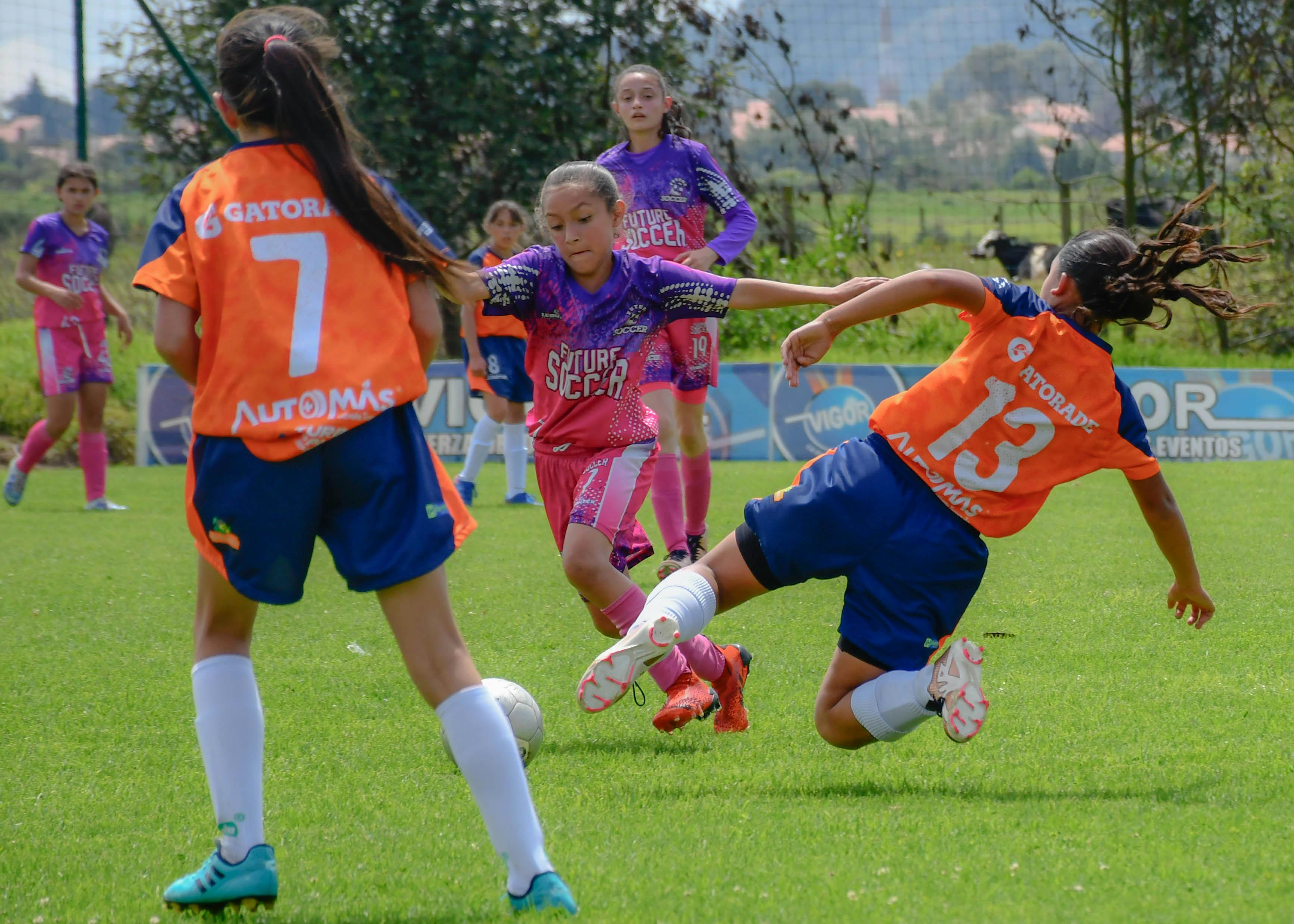
Every fall, the same conversation happens in parking lots across the country.
Another family just switched clubs. Their kid is now in ECNL. Or GA. Or MLS Next. And they're convinced it changes everything.
"The coaches actually watch those games. You can't get recruited from NPL."
Sometimes that's true.
But in a lot of cases, families are paying a significant premium for a league badge that matters far less than they've been told — while the factors that actually drive offers go unaddressed.
Here's what college coaches genuinely look at, and how to match your child's league to the division they're actually targeting.
(For a full overview of how NCAA soccer recruiting works — scholarship limits, contact rules, and timelines — see our NCAA Soccer Recruiting & Scholarship Resource.)
————-
Before you chase the league badge, read this.
Most families don't find out they picked the wrong path until their athlete is a junior and the recruiting window is closing. The league question is just one piece — and getting it right while missing everything else is just as costly. The Soccer Scholarship Playbook covers the complete system: what coaches evaluate, how to get on their radar, and how to avoid the mistakes that quietly end recruiting chances before they start.
Don't Get This Wrong — Get the Playbook →
—————
First: The U.S. Youth Soccer League Hierarchy (Simplified)
The U.S. doesn't have a single national soccer pyramid the way most countries do. Instead, there are multiple overlapping national and regional leagues competing for the same players. Here's how they map to recruiting exposure:
Girls leagues, highest to lowest recruiting visibility:
ECNL (Elite Clubs National League) — One of the two primary national pipelines for girls. D1 coaches attend ECNL national events and regional showcases consistently, alongside GA, making these two circuits the standard for top-level girls' recruiting exposure.
Girls Academy (GA) — Strong alternative to ECNL with significant D1 and D2 coach presence at national events. Players can also play high school soccer, which ECNL historically restricted.
ECRL (Elite Club Regional League) — ECNL's regional feeder. Solid D2 and D3 exposure. Growing in prominence as coaches cast wider nets.
DPL (Development Player League) — Regional competition with D2, D3, and NAIA recruiting relevance.
NPL / State leagues — Varies significantly by region. Top clubs in competitive states recruit to D2, D3, and NAIA regularly.
Boys leagues, highest to lowest recruiting visibility:
MLS Next — The top scouted boys circuit for elite programs. Power-5 D1 coaches spend the majority of their evaluation time here.
ECNL Boys — Strong alternative, particularly for regions where MLS Next clubs aren't accessible. Significant D1 and D2 presence.
ECRL Boys / Regional leagues — Solid D2, D3, and NAIA pathways. Top clubs in strong markets get meaningful college coach traffic.
NPL / State leagues — Recruiting outcomes vary by club strength and regional market, not just league affiliation.
What the Data Shows About D1 Recruiting by League
Here's where most families are surprised.
The data on D1 recruiting outcomes is fairly clear: the large majority of players signing with Power-conference D1 programs come from ECNL, GA, or MLS Next. For girls, ECNL and GA players combined account for the significant majority of D1 women's soccer recruits nationally. For boys, MLS Next and ECNL Boys dominate the D1 pipeline.
But here's the nuance that stat doesn't capture:
Playing in ECNL or MLS Next doesn't get your child recruited. Being in the top tier of players within whatever league they're in does.
A standout contributor on a strong NPL team will get more D1 looks than a bench player on a mid-tier ECNL team. The league creates the platform. The player earns the offer.
ECNL vs MLS Next: What's the Actual Difference for Recruiting?
This is the comparison most families are really asking. Here's the direct answer:
ECNL and MLS Next serve different populations and operate differently, but both sit at the top of their respective pipelines.
ECNL is the primary national circuit for girls and runs its own national events and regional showcases where D1 coaches concentrate their evaluation time. It has historically restricted players from also competing in high school soccer, though individual club policies vary.
MLS Next is the top boys circuit, operated by Major League Soccer clubs. Power-5 D1 coaches prioritize MLS Next events above all others for boys evaluation. The infrastructure and scouting presence is unmatched at the elite level.
ECNL Boys is a strong alternative in markets where MLS Next clubs aren't accessible — significant D1 and D2 coach presence attends ECNL Boys national events.
The bottom line on the comparison: if your son is targeting Power-5 D1, MLS Next is where the coaches are. If your daughter is targeting Power-5 D1, ECNL and GA are equivalent. For D2 and below, the gap between leagues narrows considerably — and being a standout contributor matters more than the patch on the jersey.
🚨 The Distinction Most Families Miss
Families almost always think about league selection as a recruiting decision.
Coaches think about it as a filtering tool — a first pass that helps them decide where to spend their limited evaluation time.
That's an important distinction.
If your child is in a lower league but generating dominant film, playing meaningful minutes, and attending the right showcases — coaches will find them.
If your child is in ECNL or MLS Next but sitting the bench or playing a marginal role — the league name won't save them.
The uncomfortable question isn't "which league are they in?" It's "what are they actually doing when they play?"
—————
The League Gets Coaches in the Building. Everything After That Is On You.
You've got the league sorted. But here's where most families stall — they don't know what to do next, in what order, or whether they're already behind. The Soccer Scholarship Playbook maps every step of the process in sequence: outreach timing, highlight video blueprint, visit prep, scholarship negotiation. Nothing to figure out as you go. Nothing to accidentally miss.
—————
D1, D2, D3: What Level of League Do You Actually Need?
This is the question most families skip — and it's the most important one.
Targeting D1 Soccer
For players targeting Power-conference D1 programs, ECNL or GA (girls) and MLS Next or ECNL Boys (boys) are the realistic minimum — not because of the badge, but because those are where top coaches spend the most evaluation time.
That said, mid-major D1 programs cast a significantly wider net. Players from strong NPL and regional clubs receive D1 offers regularly, especially when they're dominant contributors, compete at well-attended showcases, and run deliberate outreach campaigns.
Realistic benchmarks for D1:
Power-5 programs (girls): Top contributor on a competitive ECNL or GA team
Power-5 programs (boys): Top contributor in MLS Next or ECNL Boys
Mid-major D1: Strong ECNL, GA, top NPL — being a standout matters more than the patch
Targeting D2 Soccer
D2 programs recruit heavily across all leagues. This is actually where strong NPL and regional league players have real traction — coaches at this level are actively looking beyond the top circuits for overlooked talent.
D2 men's soccer offers up to 9 equivalency scholarships. D2 women's soccer offers up to 9.9. Both can be split, meaning partial awards are common.
Realistic benchmarks for D2:
Girls: Competitive ECRL, DPL, or top NPL — being a standout is more important than the league
Boys: Strong ECNL Boys, top regional league, or competitive NPL
Targeting D3 and NAIA
D3 programs don't offer athletic scholarships — but many academically competitive D3 schools actively recruit strong players and can guide families toward meaningful need-based and merit aid packages.
League affiliation matters much less at D3 and NAIA. Standout players from NPL, regional leagues, and even strong high school programs receive offers regularly. The emphasis shifts almost entirely to film quality, direct outreach, and being visible at the right showcase events.
The 2025 Scholarship Rule Change Families Need to Know
Starting with the 2025–26 academic year, the NCAA removed sport-specific scholarship caps for Division I schools that opt into the House v. NCAA settlement, replacing them with roster limits. For soccer, the implications are real:
D1 men's soccer: scholarship limit eliminated, tied to new roster limits
D1 women's soccer: scholarship limit eliminated, tied to new roster limits
Both remain equivalency sports — scholarships can still be split across multiple athletes
Individual schools aren't required to offer the maximum; it depends entirely on program budget
What this means in practice: there may be more scholarship dollars available at the D1 level than in previous years. But top programs with big budgets are likely to use expanded scholarships to deepen rosters rather than fundamentally change who they recruit. It doesn't change which league your child needs to compete in — it changes how much aid may be available once they're being actively recruited.
What Coaches Actually Look At (Beyond the League)
Ask any college coach what drives an offer and the answer is consistent: the league is a starting point, not the deciding factor. Here's what actually moves coaches:
Role and playing time — A starter on a mid-level team is easier to evaluate than a benchwarmer on an elite one. Coaches need to see your child in meaningful situations.
Showcase visibility — ECNL National Events and GA showcases draw the highest D1 coach traffic for girls. MLS Next showcases for boys. But NPL and regional showcases also attract college staff, particularly at the D2 and D3 level.
Film and highlights — A well-built recruiting video from any league gets coaches watching. A thin reel from a prestigious club gets ignored. Here's how to build film that coaches actually act on.
Direct outreach — Players who email coaches proactively get recruited from NPL teams regularly. College coaches are direct about this: they respond to athletes who make evaluation easy.
Academics — Every division has academic minimums. For D1 and D2, contact begins June 15 after sophomore year. A strong GPA opens doors across all levels.
Position scarcity — Goalkeepers and specialty positions get recruited from lower leagues more readily than forwards and midfielders. If your child plays a scarce position, the league matters less.
The Regional Reality: League Strength Varies Enormously by Market
One of the most misunderstood dynamics in youth soccer is how regional the landscape actually is.
A top ECNL club in California or Texas is a fundamentally different environment than a mid-tier ECNL club in a smaller market. In some regions, the strongest NPL or state league club fields better competition and more college coach traffic than the local ECNL entry.
Before committing to a league based on the name alone, ask these questions about the specific club:
What is this club's D1 placement rate over the last three years?
Which college coaches attended their last two or three showcases?
How many players from this team are currently playing at the level we're targeting?
Is the coach experienced with the recruiting process and actively helping players get exposure?
The answers to those questions matter more than whether the jersey says ECNL, GA, or NPL.
Matching League to Division: A Practical Framework
These are typical pathways, not absolute rules — exceptional players occasionally get recruited from outside these leagues, and regional market strength always plays a role.
Target Division | Girls — Realistic Minimum | Boys — Realistic Minimum | Most Important Factor |
|---|---|---|---|
Power-5 D1 | Top contributor, ECNL or GA | Top contributor, MLS Next | Playing time + film quality |
Mid-major D1 | Strong ECNL, GA, or standout NPL | ECNL Boys or top regional | Direct outreach + showcases |
D2 | Competitive ECRL, DPL, or top NPL | Strong ECNL Boys or NPL | Being a standout, any league |
D3 / NAIA | Any competitive league | Any competitive league | Film, outreach, academics |
The recruiting timeline matters here too. D1 and D2 coaches begin building watchlists from national events as early as Grade 9, with official contact opening June 15 after Grade 10. A player who spends Grade 9 and 10 in a low-visibility role — regardless of league — enters the critical recruiting window behind.
The Bottom Line
The most expensive club isn't always the best recruiting path.
The right question isn't "which league is best?" It's "which club, in which league, gives my child the best combination of development, playing time, and college exposure for the division we're actually targeting?"
A dominant contributor on a competitive NPL team — with clean film, active outreach, and presence at the right showcases — will out-recruit a bench player in ECNL or MLS Next almost every time.
The league gets coaches in the building. Your child has to earn what happens next.
For everything else that goes into a complete soccer recruiting plan — scholarship structures, contact rules, what coaches evaluate position by position, and how to run outreach that actually gets responses — visit our full NCAA Soccer Recruiting & Scholarship Resource.
Frequently Asked Questions
Does my child need to be in ECNL to get a D1 soccer scholarship?
For Power-conference D1 programs, ECNL (girls) and MLS Next (boys) are where the top coaches spend most of their evaluation time — so visibility is higher there. But mid-major D1 programs recruit from GA, ECRL, and strong NPL clubs regularly. What matters most is being a standout contributor with clean film and a deliberate outreach strategy, not just the badge on the jersey.
What is the difference between ECNL and Girls Academy (GA)?
Both are top-tier national leagues for girls. The main practical difference is that GA allows players to also compete in high school soccer, which ECNL historically restricted. In terms of D1 recruiting exposure, both carry significant weight — coaches attend national events for both circuits. The better fit depends on your child's club options, regional market, and whether high school soccer is important to them.
What is MLS Next and how does it affect boys recruiting?
MLS Next is the top scouted boys circuit in the country, operated by Major League Soccer. Power-5 D1 coaches prioritize MLS Next events for elite evaluation. ECNL Boys is a strong alternative, particularly in regions where MLS Next clubs aren't accessible or affordable. For D2 and below, regional leagues and NPL carry significant recruiting weight.
Can a player get recruited from NPL or a regional league?
Yes — regularly, especially at the D2, D3, and NAIA levels. Even some mid-major D1 programs actively recruit outside ECNL and MLS Next, particularly for scarce positions like goalkeeper. The key is generating strong film, attending well-attended showcases, and running proactive outreach to coaches. League affiliation alone doesn't create offers — visibility and evaluation ease do.
When do college soccer coaches start recruiting?
Coaches begin building informal watchlists from national events as early as Grade 9. Official contact — emails, calls — can begin June 15 after Grade 10 for D1 and D2 programs. Most serious D1 commitments happen during Grade 11. D3 and NAIA programs recruit on a later timeline, with real opportunities extending into Grade 12.
How has the 2025 NCAA rule change affected soccer scholarships?
The House v. NCAA settlement eliminated D1 scholarship limits starting in 2025–26, tying scholarship availability to new roster limits instead. Soccer remains an equivalency sport, meaning scholarships can still be split. Individual programs aren't required to offer the maximum — it depends on each school's budget. More scholarship dollars may be available at the D1 level, but it doesn't change the fundamental recruiting pathway.
Does playing high school soccer hurt club recruiting?
It depends on the league. GA allows high school participation; ECNL has historically restricted it (policies have evolved — check your specific club's current rules). For most players, high school soccer doesn't significantly help or hurt recruiting on its own. What matters is visibility at the right club showcases during the recruiting window.
—————
The Parent Who Did the Work Looks Like This
Picture being the parent at the next tournament whose kid just committed. Not because you got lucky — because you followed the right process, hit every window, and gave your player every possible advantage. While other families are still trying to figure out the league question, yours already moved on to the part that actually produces offers. That's what doing this right looks like.
I Want That Outcome — Get the Playbook →
—————
Internal Links Used in This Post
Every fall, the same conversation happens in parking lots across the country.
Another family just switched clubs. Their kid is now in ECNL. Or GA. Or MLS Next. And they're convinced it changes everything.
"The coaches actually watch those games. You can't get recruited from NPL."
Sometimes that's true.
But in a lot of cases, families are paying a significant premium for a league badge that matters far less than they've been told — while the factors that actually drive offers go unaddressed.
Here's what college coaches genuinely look at, and how to match your child's league to the division they're actually targeting.
(For a full overview of how NCAA soccer recruiting works — scholarship limits, contact rules, and timelines — see our NCAA Soccer Recruiting & Scholarship Resource.)
————-
Before you chase the league badge, read this.
Most families don't find out they picked the wrong path until their athlete is a junior and the recruiting window is closing. The league question is just one piece — and getting it right while missing everything else is just as costly. The Soccer Scholarship Playbook covers the complete system: what coaches evaluate, how to get on their radar, and how to avoid the mistakes that quietly end recruiting chances before they start.
Don't Get This Wrong — Get the Playbook →
—————
First: The U.S. Youth Soccer League Hierarchy (Simplified)
The U.S. doesn't have a single national soccer pyramid the way most countries do. Instead, there are multiple overlapping national and regional leagues competing for the same players. Here's how they map to recruiting exposure:
Girls leagues, highest to lowest recruiting visibility:
ECNL (Elite Clubs National League) — One of the two primary national pipelines for girls. D1 coaches attend ECNL national events and regional showcases consistently, alongside GA, making these two circuits the standard for top-level girls' recruiting exposure.
Girls Academy (GA) — Strong alternative to ECNL with significant D1 and D2 coach presence at national events. Players can also play high school soccer, which ECNL historically restricted.
ECRL (Elite Club Regional League) — ECNL's regional feeder. Solid D2 and D3 exposure. Growing in prominence as coaches cast wider nets.
DPL (Development Player League) — Regional competition with D2, D3, and NAIA recruiting relevance.
NPL / State leagues — Varies significantly by region. Top clubs in competitive states recruit to D2, D3, and NAIA regularly.
Boys leagues, highest to lowest recruiting visibility:
MLS Next — The top scouted boys circuit for elite programs. Power-5 D1 coaches spend the majority of their evaluation time here.
ECNL Boys — Strong alternative, particularly for regions where MLS Next clubs aren't accessible. Significant D1 and D2 presence.
ECRL Boys / Regional leagues — Solid D2, D3, and NAIA pathways. Top clubs in strong markets get meaningful college coach traffic.
NPL / State leagues — Recruiting outcomes vary by club strength and regional market, not just league affiliation.
What the Data Shows About D1 Recruiting by League
Here's where most families are surprised.
The data on D1 recruiting outcomes is fairly clear: the large majority of players signing with Power-conference D1 programs come from ECNL, GA, or MLS Next. For girls, ECNL and GA players combined account for the significant majority of D1 women's soccer recruits nationally. For boys, MLS Next and ECNL Boys dominate the D1 pipeline.
But here's the nuance that stat doesn't capture:
Playing in ECNL or MLS Next doesn't get your child recruited. Being in the top tier of players within whatever league they're in does.
A standout contributor on a strong NPL team will get more D1 looks than a bench player on a mid-tier ECNL team. The league creates the platform. The player earns the offer.
ECNL vs MLS Next: What's the Actual Difference for Recruiting?
This is the comparison most families are really asking. Here's the direct answer:
ECNL and MLS Next serve different populations and operate differently, but both sit at the top of their respective pipelines.
ECNL is the primary national circuit for girls and runs its own national events and regional showcases where D1 coaches concentrate their evaluation time. It has historically restricted players from also competing in high school soccer, though individual club policies vary.
MLS Next is the top boys circuit, operated by Major League Soccer clubs. Power-5 D1 coaches prioritize MLS Next events above all others for boys evaluation. The infrastructure and scouting presence is unmatched at the elite level.
ECNL Boys is a strong alternative in markets where MLS Next clubs aren't accessible — significant D1 and D2 coach presence attends ECNL Boys national events.
The bottom line on the comparison: if your son is targeting Power-5 D1, MLS Next is where the coaches are. If your daughter is targeting Power-5 D1, ECNL and GA are equivalent. For D2 and below, the gap between leagues narrows considerably — and being a standout contributor matters more than the patch on the jersey.
🚨 The Distinction Most Families Miss
Families almost always think about league selection as a recruiting decision.
Coaches think about it as a filtering tool — a first pass that helps them decide where to spend their limited evaluation time.
That's an important distinction.
If your child is in a lower league but generating dominant film, playing meaningful minutes, and attending the right showcases — coaches will find them.
If your child is in ECNL or MLS Next but sitting the bench or playing a marginal role — the league name won't save them.
The uncomfortable question isn't "which league are they in?" It's "what are they actually doing when they play?"
—————
The League Gets Coaches in the Building. Everything After That Is On You.
You've got the league sorted. But here's where most families stall — they don't know what to do next, in what order, or whether they're already behind. The Soccer Scholarship Playbook maps every step of the process in sequence: outreach timing, highlight video blueprint, visit prep, scholarship negotiation. Nothing to figure out as you go. Nothing to accidentally miss.
—————
D1, D2, D3: What Level of League Do You Actually Need?
This is the question most families skip — and it's the most important one.
Targeting D1 Soccer
For players targeting Power-conference D1 programs, ECNL or GA (girls) and MLS Next or ECNL Boys (boys) are the realistic minimum — not because of the badge, but because those are where top coaches spend the most evaluation time.
That said, mid-major D1 programs cast a significantly wider net. Players from strong NPL and regional clubs receive D1 offers regularly, especially when they're dominant contributors, compete at well-attended showcases, and run deliberate outreach campaigns.
Realistic benchmarks for D1:
Power-5 programs (girls): Top contributor on a competitive ECNL or GA team
Power-5 programs (boys): Top contributor in MLS Next or ECNL Boys
Mid-major D1: Strong ECNL, GA, top NPL — being a standout matters more than the patch
Targeting D2 Soccer
D2 programs recruit heavily across all leagues. This is actually where strong NPL and regional league players have real traction — coaches at this level are actively looking beyond the top circuits for overlooked talent.
D2 men's soccer offers up to 9 equivalency scholarships. D2 women's soccer offers up to 9.9. Both can be split, meaning partial awards are common.
Realistic benchmarks for D2:
Girls: Competitive ECRL, DPL, or top NPL — being a standout is more important than the league
Boys: Strong ECNL Boys, top regional league, or competitive NPL
Targeting D3 and NAIA
D3 programs don't offer athletic scholarships — but many academically competitive D3 schools actively recruit strong players and can guide families toward meaningful need-based and merit aid packages.
League affiliation matters much less at D3 and NAIA. Standout players from NPL, regional leagues, and even strong high school programs receive offers regularly. The emphasis shifts almost entirely to film quality, direct outreach, and being visible at the right showcase events.
The 2025 Scholarship Rule Change Families Need to Know
Starting with the 2025–26 academic year, the NCAA removed sport-specific scholarship caps for Division I schools that opt into the House v. NCAA settlement, replacing them with roster limits. For soccer, the implications are real:
D1 men's soccer: scholarship limit eliminated, tied to new roster limits
D1 women's soccer: scholarship limit eliminated, tied to new roster limits
Both remain equivalency sports — scholarships can still be split across multiple athletes
Individual schools aren't required to offer the maximum; it depends entirely on program budget
What this means in practice: there may be more scholarship dollars available at the D1 level than in previous years. But top programs with big budgets are likely to use expanded scholarships to deepen rosters rather than fundamentally change who they recruit. It doesn't change which league your child needs to compete in — it changes how much aid may be available once they're being actively recruited.
What Coaches Actually Look At (Beyond the League)
Ask any college coach what drives an offer and the answer is consistent: the league is a starting point, not the deciding factor. Here's what actually moves coaches:
Role and playing time — A starter on a mid-level team is easier to evaluate than a benchwarmer on an elite one. Coaches need to see your child in meaningful situations.
Showcase visibility — ECNL National Events and GA showcases draw the highest D1 coach traffic for girls. MLS Next showcases for boys. But NPL and regional showcases also attract college staff, particularly at the D2 and D3 level.
Film and highlights — A well-built recruiting video from any league gets coaches watching. A thin reel from a prestigious club gets ignored. Here's how to build film that coaches actually act on.
Direct outreach — Players who email coaches proactively get recruited from NPL teams regularly. College coaches are direct about this: they respond to athletes who make evaluation easy.
Academics — Every division has academic minimums. For D1 and D2, contact begins June 15 after sophomore year. A strong GPA opens doors across all levels.
Position scarcity — Goalkeepers and specialty positions get recruited from lower leagues more readily than forwards and midfielders. If your child plays a scarce position, the league matters less.
The Regional Reality: League Strength Varies Enormously by Market
One of the most misunderstood dynamics in youth soccer is how regional the landscape actually is.
A top ECNL club in California or Texas is a fundamentally different environment than a mid-tier ECNL club in a smaller market. In some regions, the strongest NPL or state league club fields better competition and more college coach traffic than the local ECNL entry.
Before committing to a league based on the name alone, ask these questions about the specific club:
What is this club's D1 placement rate over the last three years?
Which college coaches attended their last two or three showcases?
How many players from this team are currently playing at the level we're targeting?
Is the coach experienced with the recruiting process and actively helping players get exposure?
The answers to those questions matter more than whether the jersey says ECNL, GA, or NPL.
Matching League to Division: A Practical Framework
These are typical pathways, not absolute rules — exceptional players occasionally get recruited from outside these leagues, and regional market strength always plays a role.
Target Division | Girls — Realistic Minimum | Boys — Realistic Minimum | Most Important Factor |
|---|---|---|---|
Power-5 D1 | Top contributor, ECNL or GA | Top contributor, MLS Next | Playing time + film quality |
Mid-major D1 | Strong ECNL, GA, or standout NPL | ECNL Boys or top regional | Direct outreach + showcases |
D2 | Competitive ECRL, DPL, or top NPL | Strong ECNL Boys or NPL | Being a standout, any league |
D3 / NAIA | Any competitive league | Any competitive league | Film, outreach, academics |
The recruiting timeline matters here too. D1 and D2 coaches begin building watchlists from national events as early as Grade 9, with official contact opening June 15 after Grade 10. A player who spends Grade 9 and 10 in a low-visibility role — regardless of league — enters the critical recruiting window behind.
The Bottom Line
The most expensive club isn't always the best recruiting path.
The right question isn't "which league is best?" It's "which club, in which league, gives my child the best combination of development, playing time, and college exposure for the division we're actually targeting?"
A dominant contributor on a competitive NPL team — with clean film, active outreach, and presence at the right showcases — will out-recruit a bench player in ECNL or MLS Next almost every time.
The league gets coaches in the building. Your child has to earn what happens next.
For everything else that goes into a complete soccer recruiting plan — scholarship structures, contact rules, what coaches evaluate position by position, and how to run outreach that actually gets responses — visit our full NCAA Soccer Recruiting & Scholarship Resource.
Frequently Asked Questions
Does my child need to be in ECNL to get a D1 soccer scholarship?
For Power-conference D1 programs, ECNL (girls) and MLS Next (boys) are where the top coaches spend most of their evaluation time — so visibility is higher there. But mid-major D1 programs recruit from GA, ECRL, and strong NPL clubs regularly. What matters most is being a standout contributor with clean film and a deliberate outreach strategy, not just the badge on the jersey.
What is the difference between ECNL and Girls Academy (GA)?
Both are top-tier national leagues for girls. The main practical difference is that GA allows players to also compete in high school soccer, which ECNL historically restricted. In terms of D1 recruiting exposure, both carry significant weight — coaches attend national events for both circuits. The better fit depends on your child's club options, regional market, and whether high school soccer is important to them.
What is MLS Next and how does it affect boys recruiting?
MLS Next is the top scouted boys circuit in the country, operated by Major League Soccer. Power-5 D1 coaches prioritize MLS Next events for elite evaluation. ECNL Boys is a strong alternative, particularly in regions where MLS Next clubs aren't accessible or affordable. For D2 and below, regional leagues and NPL carry significant recruiting weight.
Can a player get recruited from NPL or a regional league?
Yes — regularly, especially at the D2, D3, and NAIA levels. Even some mid-major D1 programs actively recruit outside ECNL and MLS Next, particularly for scarce positions like goalkeeper. The key is generating strong film, attending well-attended showcases, and running proactive outreach to coaches. League affiliation alone doesn't create offers — visibility and evaluation ease do.
When do college soccer coaches start recruiting?
Coaches begin building informal watchlists from national events as early as Grade 9. Official contact — emails, calls — can begin June 15 after Grade 10 for D1 and D2 programs. Most serious D1 commitments happen during Grade 11. D3 and NAIA programs recruit on a later timeline, with real opportunities extending into Grade 12.
How has the 2025 NCAA rule change affected soccer scholarships?
The House v. NCAA settlement eliminated D1 scholarship limits starting in 2025–26, tying scholarship availability to new roster limits instead. Soccer remains an equivalency sport, meaning scholarships can still be split. Individual programs aren't required to offer the maximum — it depends on each school's budget. More scholarship dollars may be available at the D1 level, but it doesn't change the fundamental recruiting pathway.
Does playing high school soccer hurt club recruiting?
It depends on the league. GA allows high school participation; ECNL has historically restricted it (policies have evolved — check your specific club's current rules). For most players, high school soccer doesn't significantly help or hurt recruiting on its own. What matters is visibility at the right club showcases during the recruiting window.
—————
The Parent Who Did the Work Looks Like This
Picture being the parent at the next tournament whose kid just committed. Not because you got lucky — because you followed the right process, hit every window, and gave your player every possible advantage. While other families are still trying to figure out the league question, yours already moved on to the part that actually produces offers. That's what doing this right looks like.
I Want That Outcome — Get the Playbook →
—————
Internal Links Used in This Post
It's not the most talented kids who get scholarships.
It's the ones with the right plan.
Our playbooks break down timelines, outreach,
and scholarship realities - by sport.
It's not the most talented kids who get scholarships.
It's the ones with the right plan.
Our playbooks break down timelines, outreach,
and scholarship realities - by sport.