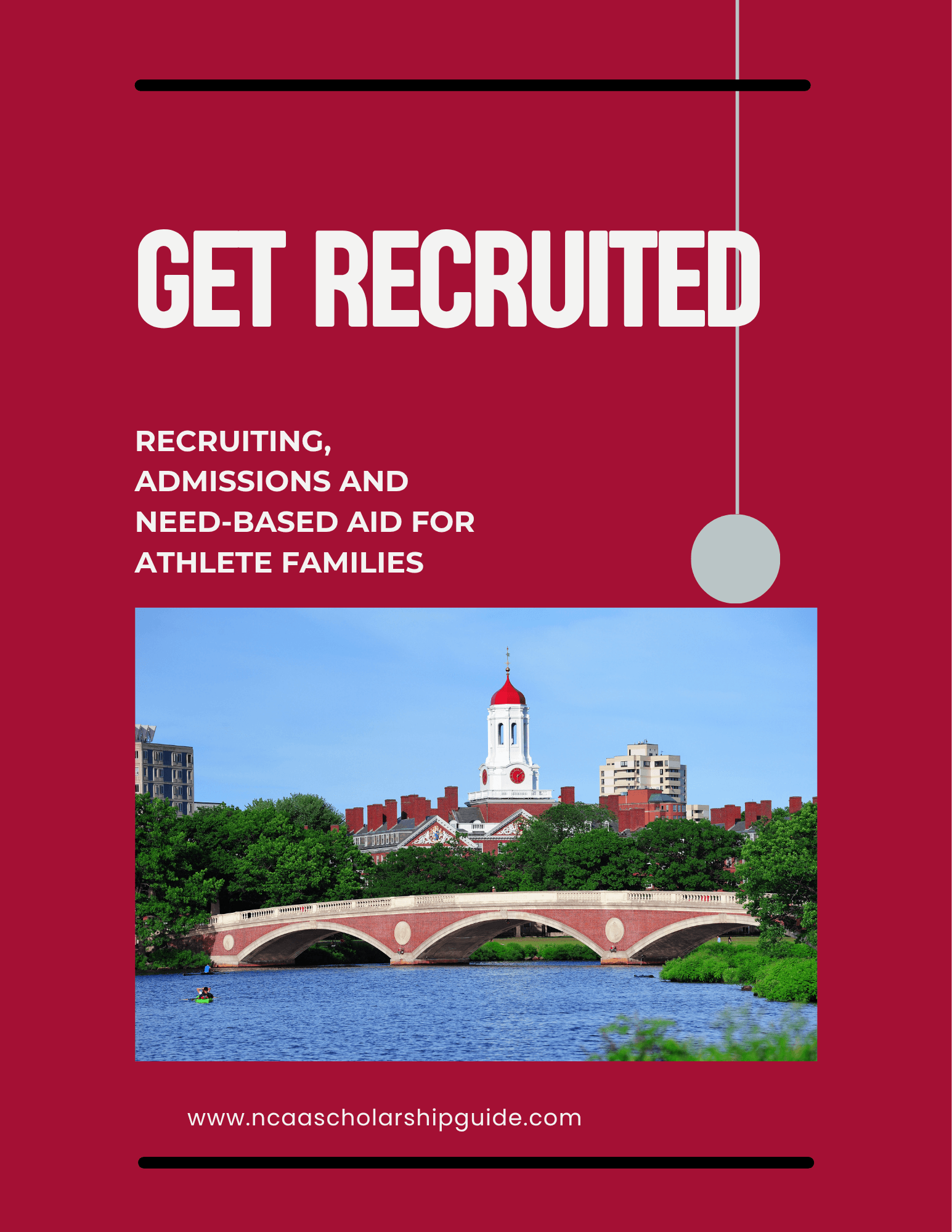
Get Recruited: The Ivy League Guide
$49
The family's guide to Ivy League recruiting, admissions, and need-based aid — so you don't cross off the right school before running the numbers.
Most families cross off the Ivies and never run the numbers. For a large share of recruited athlete families, an Ivy costs less out of pocket than a partial scholarship elsewhere — this guide shows exactly what your family would pay
Covers what nobody tells you: the Academic Index that gates recruiting before a coach can act, the likely letter that replaces the National Letter of Intent, and how the pre-read process works — the Ivy recruiting playbook runs completely differently from every other D-I program
An Ivy League degree carries weight in every room your athlete will ever walk into. This guide shows you how to get there — financially, academically, and through the admissions process
School-by-school aid comparison, net cost scenarios across income bands, grade-by-grade action plan, route comparison table, FAQ, full glossary, and tools reference — everything before, during, and after the recruiting conversation
Less than a family dinner out. The school your athlete attends shapes the next four years and beyond. Don't cross off the right school before running the numbers
30-day satisfaction guarantee. If you've worked through the guide and don't feel it was worth your investment, reply to your receipt email for a full refund — no questions asked.
Details
Screenshots
Most families cross off the Ivy League before running a single number. "No athletic scholarships" becomes "we can't afford it" — and the conversation ends before it starts.
That assumption can cost over $100,000.
The Ivy League is the most recognized brand in American education. Harvard. Princeton. Yale. For most families those names feel out of reach — financially if not academically. But for recruited athletes whose families take the time to run the numbers, they're often the most affordable option on the table. Imagine telling your friends your athlete was accepted to an Ivy League school — and that it cost your family less than the scholarship offer you almost took instead.
That's not a fantasy. It happens every recruiting cycle, to families who knew how to read the numbers.
The Ivy League meets 100% of demonstrated financial need with grants, not loans. Free tuition kicks in at income levels between $75,000 and $250,000 depending on the school. For a large share of families, a need-based Ivy package costs less out of pocket than a 50% athletic scholarship at a private school that doesn't meet full need. The family that got the scholarship paid more.
And the cost is only part of the story.
An Ivy League degree opens doors that stay open for life — recruiting networks, graduate school pathways, career opportunities, and a credential that carries weight in every room your athlete will ever walk into. The athletes who get there aren't just better funded. They're better positioned for everything that comes after.
Get Recruited: The Ivy League Guide is 38 pages covering every layer of Ivy recruiting — the financial model, the academic gate, the admissions process, and how to compare an Ivy against every other offer on the table.
The problems most families run into — and what this guide solves:
They assume the Ivies are unaffordable and never run the numbers — this guide shows exactly what your family would pay across income bands, with real comparisons against partial scholarships and in-state publics
They don't know the Academic Index exists until a coach stops returning calls — this guide explains what it is, how to calculate yours, and what to do if you're below a target program's range
They treat all eight Ivies as one price — this guide shows the school-by-school differences that can mean tens of thousands of dollars for the same family
They don't understand how Ivy recruiting works — no scholarship offer, no National Letter of Intent, a completely different timeline — and they run the wrong playbook
They miss the likely letter window or misread what it means — this guide explains exactly what it guarantees, what it doesn't, and how to act on it
They don't know when to start — this guide gives a grade-by-grade action plan from 9th through 12th grade so nothing is missed and nothing is rushed
What's inside:
How Ivy need-based aid works and why the sticker price is almost never what aided families pay
School-by-school aid comparison: free-tuition income lines, strongest aid tiers, and what each school actually covers
Net cost scenarios across income bands — what your family would actually pay vs. a partial athletic scholarship vs. in-state public, totaled over four years
The Academic Index: how to calculate yours, what the bands mean, and how coaches use it to decide who they can recruit
How Ivy recruiting differs from standard D-I: the pre-read, coach support tiers, the likely letter, and why there's no athletic money to negotiate
The application process: early vs. regular decision, mandatory testing requirements, essays, NCAA Eligibility Center registration, and deadlines
International and Canadian families: need-blind vs. need-aware by school, CSS Profile and IDOC, foreign transcript evaluation, and amateurism rules
Ivy vs. other high-academic routes: Patriot League, NESCAC, UAA, and academic D-I programs that give athletic money — when each one beats an Ivy
Grade-by-grade action plan tying academics, testing, coach outreach, and applications together from 9th through 12th grade
Also includes: school-by-school reference table, net cost scenario tables, route comparison table, coach outreach framework, FAQ, full glossary, and tools and links reference.
The Ivy League isn't out of reach because of money. For most families it's out of reach because nobody told them how it actually works.
This guide does.
At less than a family dinner out — everything your family needs to decide whether the Ivy League belongs on your list, and exactly how to pursue it if it does.
Details
Screenshots
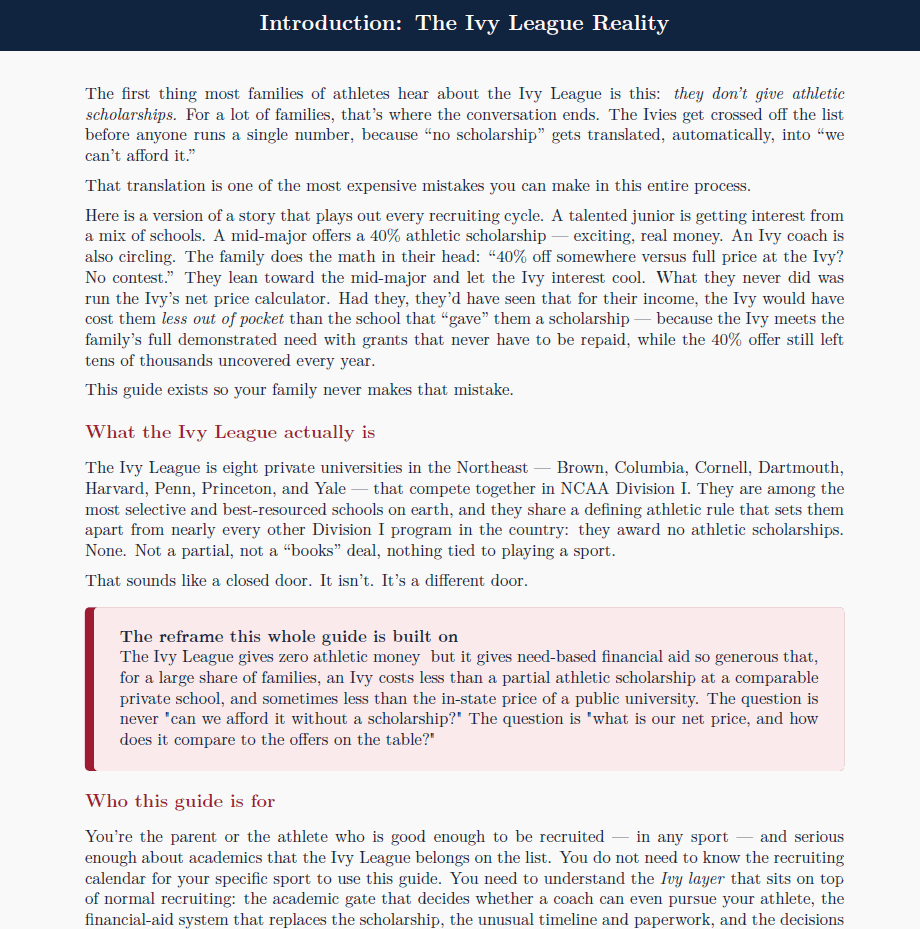
Most families cross off the Ivy League before running a single number. "No athletic scholarships" becomes "we can't afford it" — and the conversation ends before it starts.
That assumption can cost over $100,000.
The Ivy League is the most recognized brand in American education. Harvard. Princeton. Yale. For most families those names feel out of reach — financially if not academically. But for recruited athletes whose families take the time to run the numbers, they're often the most affordable option on the table. Imagine telling your friends your athlete was accepted to an Ivy League school — and that it cost your family less than the scholarship offer you almost took instead.
That's not a fantasy. It happens every recruiting cycle, to families who knew how to read the numbers.
The Ivy League meets 100% of demonstrated financial need with grants, not loans. Free tuition kicks in at income levels between $75,000 and $250,000 depending on the school. For a large share of families, a need-based Ivy package costs less out of pocket than a 50% athletic scholarship at a private school that doesn't meet full need. The family that got the scholarship paid more.
And the cost is only part of the story.
An Ivy League degree opens doors that stay open for life — recruiting networks, graduate school pathways, career opportunities, and a credential that carries weight in every room your athlete will ever walk into. The athletes who get there aren't just better funded. They're better positioned for everything that comes after.
Get Recruited: The Ivy League Guide is 38 pages covering every layer of Ivy recruiting — the financial model, the academic gate, the admissions process, and how to compare an Ivy against every other offer on the table.
The problems most families run into — and what this guide solves:
They assume the Ivies are unaffordable and never run the numbers — this guide shows exactly what your family would pay across income bands, with real comparisons against partial scholarships and in-state publics
They don't know the Academic Index exists until a coach stops returning calls — this guide explains what it is, how to calculate yours, and what to do if you're below a target program's range
They treat all eight Ivies as one price — this guide shows the school-by-school differences that can mean tens of thousands of dollars for the same family
They don't understand how Ivy recruiting works — no scholarship offer, no National Letter of Intent, a completely different timeline — and they run the wrong playbook
They miss the likely letter window or misread what it means — this guide explains exactly what it guarantees, what it doesn't, and how to act on it
They don't know when to start — this guide gives a grade-by-grade action plan from 9th through 12th grade so nothing is missed and nothing is rushed
What's inside:
How Ivy need-based aid works and why the sticker price is almost never what aided families pay
School-by-school aid comparison: free-tuition income lines, strongest aid tiers, and what each school actually covers
Net cost scenarios across income bands — what your family would actually pay vs. a partial athletic scholarship vs. in-state public, totaled over four years
The Academic Index: how to calculate yours, what the bands mean, and how coaches use it to decide who they can recruit
How Ivy recruiting differs from standard D-I: the pre-read, coach support tiers, the likely letter, and why there's no athletic money to negotiate
The application process: early vs. regular decision, mandatory testing requirements, essays, NCAA Eligibility Center registration, and deadlines
International and Canadian families: need-blind vs. need-aware by school, CSS Profile and IDOC, foreign transcript evaluation, and amateurism rules
Ivy vs. other high-academic routes: Patriot League, NESCAC, UAA, and academic D-I programs that give athletic money — when each one beats an Ivy
Grade-by-grade action plan tying academics, testing, coach outreach, and applications together from 9th through 12th grade
Also includes: school-by-school reference table, net cost scenario tables, route comparison table, coach outreach framework, FAQ, full glossary, and tools and links reference.
The Ivy League isn't out of reach because of money. For most families it's out of reach because nobody told them how it actually works.
This guide does.
At less than a family dinner out — everything your family needs to decide whether the Ivy League belongs on your list, and exactly how to pursue it if it does.
Details
Screenshots
Most families cross off the Ivy League before running a single number. "No athletic scholarships" becomes "we can't afford it" — and the conversation ends before it starts.
That assumption can cost over $100,000.
The Ivy League is the most recognized brand in American education. Harvard. Princeton. Yale. For most families those names feel out of reach — financially if not academically. But for recruited athletes whose families take the time to run the numbers, they're often the most affordable option on the table. Imagine telling your friends your athlete was accepted to an Ivy League school — and that it cost your family less than the scholarship offer you almost took instead.
That's not a fantasy. It happens every recruiting cycle, to families who knew how to read the numbers.
The Ivy League meets 100% of demonstrated financial need with grants, not loans. Free tuition kicks in at income levels between $75,000 and $250,000 depending on the school. For a large share of families, a need-based Ivy package costs less out of pocket than a 50% athletic scholarship at a private school that doesn't meet full need. The family that got the scholarship paid more.
And the cost is only part of the story.
An Ivy League degree opens doors that stay open for life — recruiting networks, graduate school pathways, career opportunities, and a credential that carries weight in every room your athlete will ever walk into. The athletes who get there aren't just better funded. They're better positioned for everything that comes after.
Get Recruited: The Ivy League Guide is 38 pages covering every layer of Ivy recruiting — the financial model, the academic gate, the admissions process, and how to compare an Ivy against every other offer on the table.
The problems most families run into — and what this guide solves:
They assume the Ivies are unaffordable and never run the numbers — this guide shows exactly what your family would pay across income bands, with real comparisons against partial scholarships and in-state publics
They don't know the Academic Index exists until a coach stops returning calls — this guide explains what it is, how to calculate yours, and what to do if you're below a target program's range
They treat all eight Ivies as one price — this guide shows the school-by-school differences that can mean tens of thousands of dollars for the same family
They don't understand how Ivy recruiting works — no scholarship offer, no National Letter of Intent, a completely different timeline — and they run the wrong playbook
They miss the likely letter window or misread what it means — this guide explains exactly what it guarantees, what it doesn't, and how to act on it
They don't know when to start — this guide gives a grade-by-grade action plan from 9th through 12th grade so nothing is missed and nothing is rushed
What's inside:
How Ivy need-based aid works and why the sticker price is almost never what aided families pay
School-by-school aid comparison: free-tuition income lines, strongest aid tiers, and what each school actually covers
Net cost scenarios across income bands — what your family would actually pay vs. a partial athletic scholarship vs. in-state public, totaled over four years
The Academic Index: how to calculate yours, what the bands mean, and how coaches use it to decide who they can recruit
How Ivy recruiting differs from standard D-I: the pre-read, coach support tiers, the likely letter, and why there's no athletic money to negotiate
The application process: early vs. regular decision, mandatory testing requirements, essays, NCAA Eligibility Center registration, and deadlines
International and Canadian families: need-blind vs. need-aware by school, CSS Profile and IDOC, foreign transcript evaluation, and amateurism rules
Ivy vs. other high-academic routes: Patriot League, NESCAC, UAA, and academic D-I programs that give athletic money — when each one beats an Ivy
Grade-by-grade action plan tying academics, testing, coach outreach, and applications together from 9th through 12th grade
Also includes: school-by-school reference table, net cost scenario tables, route comparison table, coach outreach framework, FAQ, full glossary, and tools and links reference.
The Ivy League isn't out of reach because of money. For most families it's out of reach because nobody told them how it actually works.
This guide does.
At less than a family dinner out — everything your family needs to decide whether the Ivy League belongs on your list, and exactly how to pursue it if it does.
Other goods you might like
Stay Ahead of the Game — Join our Parent Insider List
Get expert tips, NCAA recruiting insights, and early access to new guides — straight to your inbox.
Your privacy is important to us. You'll only receive valuable content and updates from us.