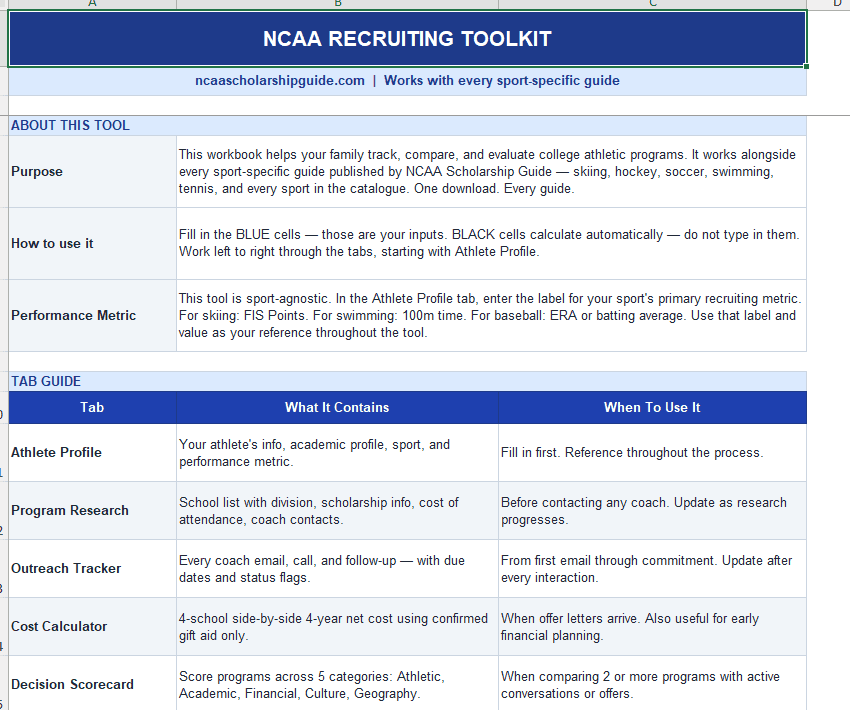
Get Recruited - The Alpine and Nordic Skiing Scholarship Playbook (2026 Edition)
$97
Most Alpine and Nordic families spend $15,000 a year on racing — and never get a single coach email back. This playbook changes that.
You're spending $15,000 a year on race fees, equipment, and travel. One coach email could change everything. Most families never send the right one. This playbook fixes that — for less than a single race weekend hotel stay.
Most families don't contact coaches until junior year. By then, half the roster spots are already spoken for. This playbook gives you the exact grade-by-grade timeline so your athlete is on coaches' radar before the competition even knows recruiting has started.
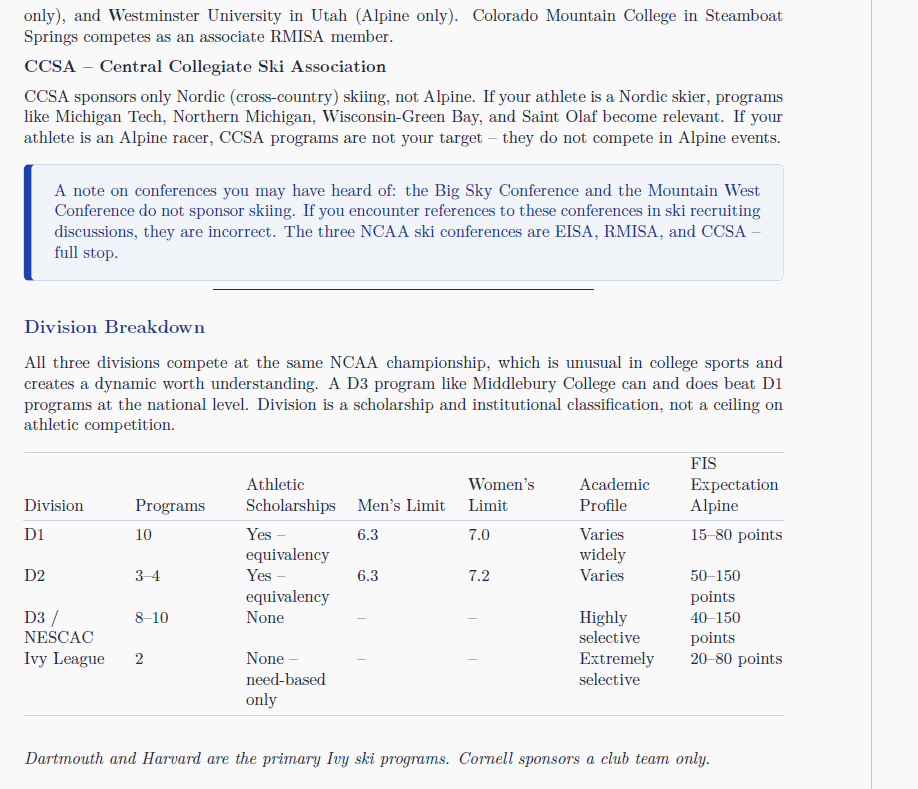
There are only 30+ NCAA ski programs in the country. Most families waste months targeting the wrong ones. This playbook maps every D1 and D2 program, the EISA and RMISA circuits, and exactly which programs match your athlete's FIS points and academic profile — so you spend zero time on schools that were never realistic.
Coaches don't recruit blind. They have FIS point thresholds in their head before they open your email. This playbook tells you exactly what those numbers are by division level — so you know whether your athlete is in the conversation before you spend a single minute on outreach.
Most families build a recruiting profile that checks every box and still hear nothing back. This playbook shows you how coaches actually evaluate skiers — technical consistency, finishing rates, academic trajectory — so your athlete's profile speaks the language coaches are listening for.
The families who land scholarship money aren't the ones with the fastest kids. They're the ones who show up at the right events, email at the right time, and follow up without being annoying. This playbook gives you the exact communication cadence — what to say, when to say it, and how to stay on a coach's radar without burning the relationship.
Full rides in skiing are rare. Partial scholarships stacked with academic aid are not — and most families leave that money on the table because they never learned how to negotiate. This playbook shows you exactly how to stack athletic and academic aid and how to negotiate an offer without damaging your relationship with the coach.
International athletes lose scholarship opportunities every year to paperwork — transcript delays, NCAA certification errors, eligibility flags that could have been avoided. This playbook walks international families through every step so a filing mistake doesn't cost your athlete a scholarship they athletically deserve.
A recruiting consultant charges $150–$300 an hour to tell you what's in this playbook. Most families spend $5,000–$15,000 on services that hand them a school list and disappear. This playbook gives you the complete system — every tool, every template, every timeline — for less than a single night at a race weekend hotel.
Work through this playbook for 30 days. If you don't have a target program list, an active coach outreach plan, and a recruiting timeline you're executing — email us and we'll refund every dollar. No forms, no hoops, no questions..
Details
Screenshots
You're Spending $15,000 a Year on Ski Racing. Do You Have a Single Scholarship Offer to Show For It?
Most Alpine and Nordic families pour years of money, weekends, and sacrifice into a sport they love — and walk away from the recruiting process with nothing. Not because their athlete wasn't good enough. Because nobody told them how it actually works.
The Problem Nobody Talks About
Here's what's really happening.
College ski coaches have FIS point thresholds in their head before they open a single recruiting email. They know which events they're attending six months in advance. They start filling roster spots earlier than most families realize recruiting has even begun.
And while your family is figuring out how NCAA recruiting works, the families who already know are locking up the scholarship money.
This isn't about talent. The athletes who get recruited aren't always the fastest ones on the mountain. They're the ones whose families understood the process, started early, contacted the right coaches the right way, and showed up at the events that actually matter.
The families who don't know this spend years and tens of thousands of dollars — and wonder why coaches never called back.
The Ugly Math
The average ski family spends $10,000–$20,000 per year on club racing fees, FIS and USSA race entries, equipment, travel, and coaching.
Over four years of high school that's $40,000–$80,000 out of pocket.
A partial NCAA scholarship at a D1 program is worth $20,000–$80,000 per year. A stacked package combining athletic and academic aid can cover nearly everything.
The families who secure that money don't have faster kids. They have a better process.
This playbook is that process. It costs less than a single race weekend hotel stay. It works year-round. And it gives your family the exact same system that recruiting consultants charge $5,000–$15,000 to walk you through — except you own it forever.
What This Playbook Actually Does
This isn't a PDF full of general advice you could find on Google. This is a discipline-specific, grade-by-grade operational system built specifically for Alpine and Nordic families navigating NCAA recruiting.
Here's what you're going to be able to do when you finish it:
Know exactly when to act. Most families contact coaches too late. You'll have a recruiting timeline starting freshman year that puts your athlete on coaches' radar before the competition knows the window is open.
Target the right programs. There are only 30+ NCAA ski programs in the country. Wasting time on schools that were never realistic is the most expensive mistake families make. You'll know exactly which D1 and D2 programs match your athlete's FIS points, discipline, and academic profile — before you send a single email.
Speak the language coaches use. Coaches evaluate Alpine athletes on FIS slalom and giant slalom points, finishing consistency, and technical progression. Nordic coaches look at classic and skate technique, sprint performance, and pack skiing ability. This playbook tells you exactly what thresholds matter at each division level — so your athlete's profile says the right things to the right people.
Get responses from coaches. Most recruiting emails get deleted in three seconds. You'll know exactly what to include — FIS results, academic profile, highlight video structure, follow-up timing — so your outreach gets read, remembered, and acted on.
Stop leaving scholarship money on the table. Full rides in skiing are rare. Stacked packages combining athletic and academic aid are not. Most families never negotiate because they don't know they can — or they're afraid of damaging the relationship. You'll know exactly how to negotiate an offer without putting a single thing at risk.
Handle every curveball. Coaching changes. Injury. A gap year. The transfer portal. Reclassification. International certification. This playbook covers every scenario that derails a recruiting process so nothing catches you off guard.
What's Inside
Chapter 1: The Grade-by-Grade Recruiting Timeline
Freshman year through signing day. Every NCAA contact date, every evaluation window, every moment that matters — mapped out so you always know what to do next.
Chapter 2: The NCAA Skiing Landscape
Every D1 and D2 program. The EISA and RMISA circuits. How rosters are structured. What differentiates an elite program from a developmental one. The full map so you can identify your real targets.
Chapter 3: Contacting Coaches the Right Way
What to include in your first coach email. FIS results, academic profile, follow-up timing, and the communication cadence that keeps you on a coach's radar without burning the relationship.
Chapter 4: The Highlight Video That Actually Gets Watched
Alpine: SL and GS runs from multiple angles with race time and FIS point overlays. Nordic: classic and skate footage with sprint finishes and pack skiing. Exactly what coaches want to see and exactly how to present it.
Chapter 5: Official and Unofficial Visit Strategy
The questions most families never think to ask — about team depth in your discipline, snow access, conditioning facilities, scholarship renewal policies, and what life actually looks like as a student-athlete at that program.
Chapter 6: NCAA Eligibility and Academic Requirements
Core course requirements. GPA targets by program tier. Standardized test strategy. Eligibility Center registration — especially critical for international athletes who lose opportunities every year to paperwork errors that were completely avoidable.
Chapter 7: Scholarship Negotiation
How skiing's equivalency model works. What partial awards look like in practice. How to stack athletic aid with merit and need-based money. The exact negotiation approach that gets results without damaging your relationship with the coach.
Chapter 8: The Events That Actually Move the Needle
NorAm Cup. U.S. Nationals. Junior Nationals. Regional carnivals. Not every race matters equally to coaches. This chapter tells you exactly which events are worth the investment and how to maximize your exposure at each one.
Chapter 9: Finding Your Best-Fit Program
Scholarship amount is one factor. Training environment, snow access, academic programs, coach tenure, team culture, and post-athletic career support are the ones most families ignore — until they're two years into the wrong program.
Chapter 10: When Plan A Doesn't Work
Gap years to lower FIS points. Junior college pathways. The transfer portal. Prep and post-grad options.
Chapter 11: Building Your Digital Recruiting Presence
A searchable athlete profile with FIS and USSS IDs, clean highlight clips, and consistent updates that coaches can find. What to post. What to never post. How to build an online presence that reinforces your recruiting profile instead of quietly undermining it.
Chapter 12: NIL for Skiers
What realistic NIL looks like in skiing — gear sponsorships, local brand partnerships, regional opportunities. Compliance rules, tax basics, and how to build a brand without putting your eligibility at risk.
Chapter 13: International Athletes
Transcript translation and evaluation. NCAA international certification. Visa requirements. Cultural adaptation to U.S. collegiate skiing. Every step international families need to take — in order — so a paperwork mistake doesn't cost your athlete a scholarship they athletically deserve.
The Guarantee
Work through this playbook for 30 days.
If you don't have a targeted program list, an active coach outreach plan, and a recruiting timeline you're executing — email us and we'll refund every dollar.
No forms. No hoops. No questions asked.
We're that confident this works. Because it does.
The Bottom Line
You are going to spend $40,000–$80,000 on ski racing over four years of high school whether you buy this playbook or not.
The only question is whether you have a system that turns that investment into scholarship money — or whether you hand it over to race fees and hotel stays and walk away with nothing.
This playbook costs less than one night at a race weekend hotel.
The scholarship it helps you secure is worth more than your car.
One Last Thing
The families who secure NCAA skiing scholarships aren't luckier than you. They aren't richer. They don't have faster kids.
They started earlier. They knew the process. They contacted the right coaches the right way at the right time.
That knowledge is what you're buying today.
Details
Screenshots
You're Spending $15,000 a Year on Ski Racing. Do You Have a Single Scholarship Offer to Show For It?
Most Alpine and Nordic families pour years of money, weekends, and sacrifice into a sport they love — and walk away from the recruiting process with nothing. Not because their athlete wasn't good enough. Because nobody told them how it actually works.
The Problem Nobody Talks About
Here's what's really happening.
College ski coaches have FIS point thresholds in their head before they open a single recruiting email. They know which events they're attending six months in advance. They start filling roster spots earlier than most families realize recruiting has even begun.
And while your family is figuring out how NCAA recruiting works, the families who already know are locking up the scholarship money.
This isn't about talent. The athletes who get recruited aren't always the fastest ones on the mountain. They're the ones whose families understood the process, started early, contacted the right coaches the right way, and showed up at the events that actually matter.
The families who don't know this spend years and tens of thousands of dollars — and wonder why coaches never called back.
The Ugly Math
The average ski family spends $10,000–$20,000 per year on club racing fees, FIS and USSA race entries, equipment, travel, and coaching.
Over four years of high school that's $40,000–$80,000 out of pocket.
A partial NCAA scholarship at a D1 program is worth $20,000–$80,000 per year. A stacked package combining athletic and academic aid can cover nearly everything.
The families who secure that money don't have faster kids. They have a better process.
This playbook is that process. It costs less than a single race weekend hotel stay. It works year-round. And it gives your family the exact same system that recruiting consultants charge $5,000–$15,000 to walk you through — except you own it forever.
What This Playbook Actually Does
This isn't a PDF full of general advice you could find on Google. This is a discipline-specific, grade-by-grade operational system built specifically for Alpine and Nordic families navigating NCAA recruiting.
Here's what you're going to be able to do when you finish it:
Know exactly when to act. Most families contact coaches too late. You'll have a recruiting timeline starting freshman year that puts your athlete on coaches' radar before the competition knows the window is open.
Target the right programs. There are only 30+ NCAA ski programs in the country. Wasting time on schools that were never realistic is the most expensive mistake families make. You'll know exactly which D1 and D2 programs match your athlete's FIS points, discipline, and academic profile — before you send a single email.
Speak the language coaches use. Coaches evaluate Alpine athletes on FIS slalom and giant slalom points, finishing consistency, and technical progression. Nordic coaches look at classic and skate technique, sprint performance, and pack skiing ability. This playbook tells you exactly what thresholds matter at each division level — so your athlete's profile says the right things to the right people.
Get responses from coaches. Most recruiting emails get deleted in three seconds. You'll know exactly what to include — FIS results, academic profile, highlight video structure, follow-up timing — so your outreach gets read, remembered, and acted on.
Stop leaving scholarship money on the table. Full rides in skiing are rare. Stacked packages combining athletic and academic aid are not. Most families never negotiate because they don't know they can — or they're afraid of damaging the relationship. You'll know exactly how to negotiate an offer without putting a single thing at risk.
Handle every curveball. Coaching changes. Injury. A gap year. The transfer portal. Reclassification. International certification. This playbook covers every scenario that derails a recruiting process so nothing catches you off guard.
What's Inside
Chapter 1: The Grade-by-Grade Recruiting Timeline
Freshman year through signing day. Every NCAA contact date, every evaluation window, every moment that matters — mapped out so you always know what to do next.
Chapter 2: The NCAA Skiing Landscape
Every D1 and D2 program. The EISA and RMISA circuits. How rosters are structured. What differentiates an elite program from a developmental one. The full map so you can identify your real targets.
Chapter 3: Contacting Coaches the Right Way
What to include in your first coach email. FIS results, academic profile, follow-up timing, and the communication cadence that keeps you on a coach's radar without burning the relationship.
Chapter 4: The Highlight Video That Actually Gets Watched
Alpine: SL and GS runs from multiple angles with race time and FIS point overlays. Nordic: classic and skate footage with sprint finishes and pack skiing. Exactly what coaches want to see and exactly how to present it.
Chapter 5: Official and Unofficial Visit Strategy
The questions most families never think to ask — about team depth in your discipline, snow access, conditioning facilities, scholarship renewal policies, and what life actually looks like as a student-athlete at that program.
Chapter 6: NCAA Eligibility and Academic Requirements
Core course requirements. GPA targets by program tier. Standardized test strategy. Eligibility Center registration — especially critical for international athletes who lose opportunities every year to paperwork errors that were completely avoidable.
Chapter 7: Scholarship Negotiation
How skiing's equivalency model works. What partial awards look like in practice. How to stack athletic aid with merit and need-based money. The exact negotiation approach that gets results without damaging your relationship with the coach.
Chapter 8: The Events That Actually Move the Needle
NorAm Cup. U.S. Nationals. Junior Nationals. Regional carnivals. Not every race matters equally to coaches. This chapter tells you exactly which events are worth the investment and how to maximize your exposure at each one.
Chapter 9: Finding Your Best-Fit Program
Scholarship amount is one factor. Training environment, snow access, academic programs, coach tenure, team culture, and post-athletic career support are the ones most families ignore — until they're two years into the wrong program.
Chapter 10: When Plan A Doesn't Work
Gap years to lower FIS points. Junior college pathways. The transfer portal. Prep and post-grad options.
Chapter 11: Building Your Digital Recruiting Presence
A searchable athlete profile with FIS and USSS IDs, clean highlight clips, and consistent updates that coaches can find. What to post. What to never post. How to build an online presence that reinforces your recruiting profile instead of quietly undermining it.
Chapter 12: NIL for Skiers
What realistic NIL looks like in skiing — gear sponsorships, local brand partnerships, regional opportunities. Compliance rules, tax basics, and how to build a brand without putting your eligibility at risk.
Chapter 13: International Athletes
Transcript translation and evaluation. NCAA international certification. Visa requirements. Cultural adaptation to U.S. collegiate skiing. Every step international families need to take — in order — so a paperwork mistake doesn't cost your athlete a scholarship they athletically deserve.
The Guarantee
Work through this playbook for 30 days.
If you don't have a targeted program list, an active coach outreach plan, and a recruiting timeline you're executing — email us and we'll refund every dollar.
No forms. No hoops. No questions asked.
We're that confident this works. Because it does.
The Bottom Line
You are going to spend $40,000–$80,000 on ski racing over four years of high school whether you buy this playbook or not.
The only question is whether you have a system that turns that investment into scholarship money — or whether you hand it over to race fees and hotel stays and walk away with nothing.
This playbook costs less than one night at a race weekend hotel.
The scholarship it helps you secure is worth more than your car.
One Last Thing
The families who secure NCAA skiing scholarships aren't luckier than you. They aren't richer. They don't have faster kids.
They started earlier. They knew the process. They contacted the right coaches the right way at the right time.
That knowledge is what you're buying today.
Details
Screenshots
You're Spending $15,000 a Year on Ski Racing. Do You Have a Single Scholarship Offer to Show For It?
Most Alpine and Nordic families pour years of money, weekends, and sacrifice into a sport they love — and walk away from the recruiting process with nothing. Not because their athlete wasn't good enough. Because nobody told them how it actually works.
The Problem Nobody Talks About
Here's what's really happening.
College ski coaches have FIS point thresholds in their head before they open a single recruiting email. They know which events they're attending six months in advance. They start filling roster spots earlier than most families realize recruiting has even begun.
And while your family is figuring out how NCAA recruiting works, the families who already know are locking up the scholarship money.
This isn't about talent. The athletes who get recruited aren't always the fastest ones on the mountain. They're the ones whose families understood the process, started early, contacted the right coaches the right way, and showed up at the events that actually matter.
The families who don't know this spend years and tens of thousands of dollars — and wonder why coaches never called back.
The Ugly Math
The average ski family spends $10,000–$20,000 per year on club racing fees, FIS and USSA race entries, equipment, travel, and coaching.
Over four years of high school that's $40,000–$80,000 out of pocket.
A partial NCAA scholarship at a D1 program is worth $20,000–$80,000 per year. A stacked package combining athletic and academic aid can cover nearly everything.
The families who secure that money don't have faster kids. They have a better process.
This playbook is that process. It costs less than a single race weekend hotel stay. It works year-round. And it gives your family the exact same system that recruiting consultants charge $5,000–$15,000 to walk you through — except you own it forever.
What This Playbook Actually Does
This isn't a PDF full of general advice you could find on Google. This is a discipline-specific, grade-by-grade operational system built specifically for Alpine and Nordic families navigating NCAA recruiting.
Here's what you're going to be able to do when you finish it:
Know exactly when to act. Most families contact coaches too late. You'll have a recruiting timeline starting freshman year that puts your athlete on coaches' radar before the competition knows the window is open.
Target the right programs. There are only 30+ NCAA ski programs in the country. Wasting time on schools that were never realistic is the most expensive mistake families make. You'll know exactly which D1 and D2 programs match your athlete's FIS points, discipline, and academic profile — before you send a single email.
Speak the language coaches use. Coaches evaluate Alpine athletes on FIS slalom and giant slalom points, finishing consistency, and technical progression. Nordic coaches look at classic and skate technique, sprint performance, and pack skiing ability. This playbook tells you exactly what thresholds matter at each division level — so your athlete's profile says the right things to the right people.
Get responses from coaches. Most recruiting emails get deleted in three seconds. You'll know exactly what to include — FIS results, academic profile, highlight video structure, follow-up timing — so your outreach gets read, remembered, and acted on.
Stop leaving scholarship money on the table. Full rides in skiing are rare. Stacked packages combining athletic and academic aid are not. Most families never negotiate because they don't know they can — or they're afraid of damaging the relationship. You'll know exactly how to negotiate an offer without putting a single thing at risk.
Handle every curveball. Coaching changes. Injury. A gap year. The transfer portal. Reclassification. International certification. This playbook covers every scenario that derails a recruiting process so nothing catches you off guard.
What's Inside
Chapter 1: The Grade-by-Grade Recruiting Timeline
Freshman year through signing day. Every NCAA contact date, every evaluation window, every moment that matters — mapped out so you always know what to do next.
Chapter 2: The NCAA Skiing Landscape
Every D1 and D2 program. The EISA and RMISA circuits. How rosters are structured. What differentiates an elite program from a developmental one. The full map so you can identify your real targets.
Chapter 3: Contacting Coaches the Right Way
What to include in your first coach email. FIS results, academic profile, follow-up timing, and the communication cadence that keeps you on a coach's radar without burning the relationship.
Chapter 4: The Highlight Video That Actually Gets Watched
Alpine: SL and GS runs from multiple angles with race time and FIS point overlays. Nordic: classic and skate footage with sprint finishes and pack skiing. Exactly what coaches want to see and exactly how to present it.
Chapter 5: Official and Unofficial Visit Strategy
The questions most families never think to ask — about team depth in your discipline, snow access, conditioning facilities, scholarship renewal policies, and what life actually looks like as a student-athlete at that program.
Chapter 6: NCAA Eligibility and Academic Requirements
Core course requirements. GPA targets by program tier. Standardized test strategy. Eligibility Center registration — especially critical for international athletes who lose opportunities every year to paperwork errors that were completely avoidable.
Chapter 7: Scholarship Negotiation
How skiing's equivalency model works. What partial awards look like in practice. How to stack athletic aid with merit and need-based money. The exact negotiation approach that gets results without damaging your relationship with the coach.
Chapter 8: The Events That Actually Move the Needle
NorAm Cup. U.S. Nationals. Junior Nationals. Regional carnivals. Not every race matters equally to coaches. This chapter tells you exactly which events are worth the investment and how to maximize your exposure at each one.
Chapter 9: Finding Your Best-Fit Program
Scholarship amount is one factor. Training environment, snow access, academic programs, coach tenure, team culture, and post-athletic career support are the ones most families ignore — until they're two years into the wrong program.
Chapter 10: When Plan A Doesn't Work
Gap years to lower FIS points. Junior college pathways. The transfer portal. Prep and post-grad options.
Chapter 11: Building Your Digital Recruiting Presence
A searchable athlete profile with FIS and USSS IDs, clean highlight clips, and consistent updates that coaches can find. What to post. What to never post. How to build an online presence that reinforces your recruiting profile instead of quietly undermining it.
Chapter 12: NIL for Skiers
What realistic NIL looks like in skiing — gear sponsorships, local brand partnerships, regional opportunities. Compliance rules, tax basics, and how to build a brand without putting your eligibility at risk.
Chapter 13: International Athletes
Transcript translation and evaluation. NCAA international certification. Visa requirements. Cultural adaptation to U.S. collegiate skiing. Every step international families need to take — in order — so a paperwork mistake doesn't cost your athlete a scholarship they athletically deserve.
The Guarantee
Work through this playbook for 30 days.
If you don't have a targeted program list, an active coach outreach plan, and a recruiting timeline you're executing — email us and we'll refund every dollar.
No forms. No hoops. No questions asked.
We're that confident this works. Because it does.
The Bottom Line
You are going to spend $40,000–$80,000 on ski racing over four years of high school whether you buy this playbook or not.
The only question is whether you have a system that turns that investment into scholarship money — or whether you hand it over to race fees and hotel stays and walk away with nothing.
This playbook costs less than one night at a race weekend hotel.
The scholarship it helps you secure is worth more than your car.
One Last Thing
The families who secure NCAA skiing scholarships aren't luckier than you. They aren't richer. They don't have faster kids.
They started earlier. They knew the process. They contacted the right coaches the right way at the right time.
That knowledge is what you're buying today.
Other goods you might like
Stay Ahead of the Game — Join our Parent Insider List
Get expert tips, NCAA recruiting insights, and early access to new guides — straight to your inbox.
Your privacy is important to us. You'll only receive valuable content and updates from us.
Stay Ahead of the Game — Join our Parent Insider List
Get expert tips, NCAA recruiting insights, and early access to new guides — straight to your inbox.
Your privacy is important to us. You'll only receive valuable content and updates from us.
Stay Ahead of the Game — Join our Parent Insider List
Get expert tips, NCAA recruiting insights, and early access to new guides — straight to your inbox.
Your privacy is important to us. You'll only receive valuable content and updates from us.