
If your daughter plays high school or club rugby, you’ve likely realized two things: she loves the sport, and the path to playing it in college is incredibly confusing.
You’ve probably heard whispered rumors about "NCAA varsity programs," "NIRA," and "USA Rugby Club teams." But when you search for how college rugby scholarships actually work, you get a tangled web of conflicting information.
This guide breaks down the exact college rugby landscape so you can position your athlete for maximum exposure and financial aid.
📌 This article is part of our comprehensive college rugby recruiting network. For a complete deep dive into every element of the process, bookmark our Ultimate College Rugby Recruiting Hub.
The Great Divide: Varsity (NIRA) vs. Club Rugby
The single most important distinction to understand is that women’s college rugby is split into two completely different universes: Varsity and Club.
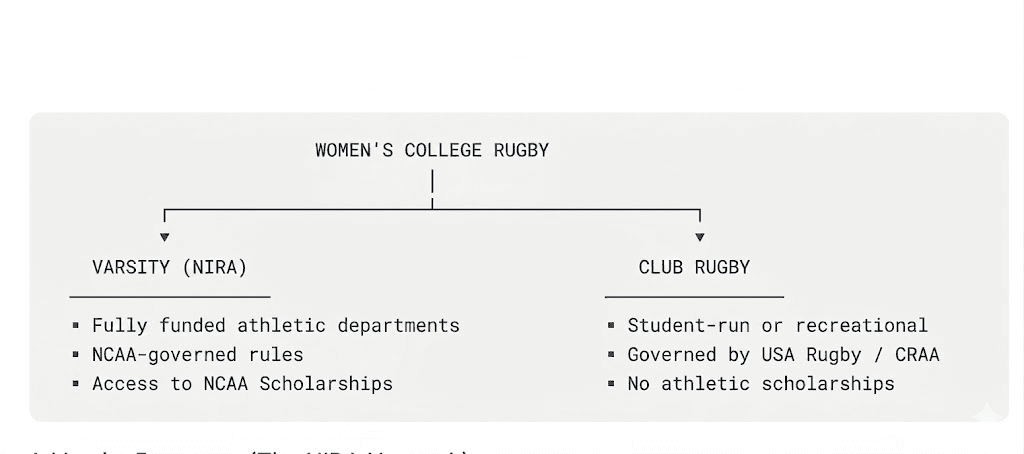
1. Varsity Programs (The NIRA Network)
In 2002, the NCAA classified women’s rugby as an "Emerging Sport for Women." To manage this growth, the National Intercollegiate Rugby Association (NIRA) was formed.
NIRA acts as the NCAA's competitive home for women’s varsity rugby. If a school is a member of NIRA, their rugby team is treated exactly like their NCAA basketball or soccer teams. They get access to varsity weight rooms, full-time athletic trainers, academic advisors, and—most importantly—official athletic scholarships.
2. Club Rugby Programs (CRAA / USA Rugby)
Club teams are typically student-run or recreational. While some club programs are highly competitive and well-funded by alumni (like Penn State or BYU), they do not sit under the school's formal athletic department.
The Catch: Club programs cannot offer NCAA athletic scholarships.
The Roster Math: How Rugby Scholarships Work
If your daughter targets an NCAA Varsity (NIRA) program, you need to understand the concept of an Equivalency Sport.
Unlike "headcount" sports like Division I basketball, where every player gets a full ride, NCAA Division I and II rugby coaches are given a pool of money equivalent to a maximum of 12 full scholarships per team.
Because a standard rugby roster requires at least 25 to 30 players, coaches almost never give out 100% full rides. Instead, they use Scholarship Stacking:
Total Aid = Partial Athletic Scholarship + Academic Merit Aid + Institutional Grants
A coach might offer your daughter a 35% athletic scholarship, and expect you to cover the rest using academic scholarships or financial aid.
Quick Reference: NIRA Division Breakdown
NCAA Division | Athletic Scholarships Available? | Max Scholarships Per School | How Aid is Administered | Notable Programs |
Division I | Yes | 12 | Partial funding stacked with merit | Harvard, Dartmouth, Brown, Army West Point |
Division II | Yes | 12 | Partial funding stacked with merit | Davenport, West Chester, Queens (NC), AIC |
Division III | No | 0 | Need-based & Academic Aid only | Bowdoin, Norwich, University of New England |
💡 The Division III Loophole: Do not ignore Division III NIRA schools just because they don't have "athletic" money. Powerhouses like Bowdoin and Norwich use preferential financial aid packages and elite institutional grants to match or exceed the financial packages offered by DI schools for high-achieving students.
The Hidden Threat: The International Pipeline
Because women's rugby is a rapidly emerging sport in the United States, youth infrastructure is still catching up. NCAA college coaches routinely look across the border and overseas to fill their rosters.
American high school players are directly competing for those 12 scholarship slots against incoming recruits from:
Canada (where girls' high school rugby infrastructure is massive)
New Zealand & Australia
The United Kingdom
To beat out international talent, your daughter cannot rely on her high school coach to get her noticed. She needs an aggressive, proactive outreach strategy.
If your daughter plays high school or club rugby, you’ve likely realized two things: she loves the sport, and the path to playing it in college is incredibly confusing.
You’ve probably heard whispered rumors about "NCAA varsity programs," "NIRA," and "USA Rugby Club teams." But when you search for how college rugby scholarships actually work, you get a tangled web of conflicting information.
This guide breaks down the exact college rugby landscape so you can position your athlete for maximum exposure and financial aid.
📌 This article is part of our comprehensive college rugby recruiting network. For a complete deep dive into every element of the process, bookmark our Ultimate College Rugby Recruiting Hub.
The Great Divide: Varsity (NIRA) vs. Club Rugby
The single most important distinction to understand is that women’s college rugby is split into two completely different universes: Varsity and Club.
1. Varsity Programs (The NIRA Network)
In 2002, the NCAA classified women’s rugby as an "Emerging Sport for Women." To manage this growth, the National Intercollegiate Rugby Association (NIRA) was formed.
NIRA acts as the NCAA's competitive home for women’s varsity rugby. If a school is a member of NIRA, their rugby team is treated exactly like their NCAA basketball or soccer teams. They get access to varsity weight rooms, full-time athletic trainers, academic advisors, and—most importantly—official athletic scholarships.
2. Club Rugby Programs (CRAA / USA Rugby)
Club teams are typically student-run or recreational. While some club programs are highly competitive and well-funded by alumni (like Penn State or BYU), they do not sit under the school's formal athletic department.
The Catch: Club programs cannot offer NCAA athletic scholarships.
The Roster Math: How Rugby Scholarships Work
If your daughter targets an NCAA Varsity (NIRA) program, you need to understand the concept of an Equivalency Sport.
Unlike "headcount" sports like Division I basketball, where every player gets a full ride, NCAA Division I and II rugby coaches are given a pool of money equivalent to a maximum of 12 full scholarships per team.
Because a standard rugby roster requires at least 25 to 30 players, coaches almost never give out 100% full rides. Instead, they use Scholarship Stacking:
Total Aid = Partial Athletic Scholarship + Academic Merit Aid + Institutional Grants
A coach might offer your daughter a 35% athletic scholarship, and expect you to cover the rest using academic scholarships or financial aid.
Quick Reference: NIRA Division Breakdown
NCAA Division | Athletic Scholarships Available? | Max Scholarships Per School | How Aid is Administered | Notable Programs |
Division I | Yes | 12 | Partial funding stacked with merit | Harvard, Dartmouth, Brown, Army West Point |
Division II | Yes | 12 | Partial funding stacked with merit | Davenport, West Chester, Queens (NC), AIC |
Division III | No | 0 | Need-based & Academic Aid only | Bowdoin, Norwich, University of New England |
💡 The Division III Loophole: Do not ignore Division III NIRA schools just because they don't have "athletic" money. Powerhouses like Bowdoin and Norwich use preferential financial aid packages and elite institutional grants to match or exceed the financial packages offered by DI schools for high-achieving students.
The Hidden Threat: The International Pipeline
Because women's rugby is a rapidly emerging sport in the United States, youth infrastructure is still catching up. NCAA college coaches routinely look across the border and overseas to fill their rosters.
American high school players are directly competing for those 12 scholarship slots against incoming recruits from:
Canada (where girls' high school rugby infrastructure is massive)
New Zealand & Australia
The United Kingdom
To beat out international talent, your daughter cannot rely on her high school coach to get her noticed. She needs an aggressive, proactive outreach strategy.
Action Plan: 3 Steps to Get on the NIRA Radar
If your daughter wants to play varsity rugby and secure a roster spot, use this three-phase framework:
1. Build a Highlight Reel Centered on "Work Rate"
Rugby coaches aren’t just looking for the girl who scores every try because she happens to be bigger than everyone else in her local league. They want to see work rate. Your film must include:
Effective tracking and technical tackles in the open field.
Speed into the breakdown and clean counter-rucking.
Offloads out of contact and vision in space.
2. Target "Exposure Events" Over Local Tournaments
Coaches have limited travel budgets. They rarely attend local high school matches. To get evaluated, your daughter needs to be at high-density scouting events. Target:
NIRA Coaches Regional Clinics (where NCAA coaches directly run the drills).
The Tropical 7s or Great North 7s tournaments.
USA Rugby Regional Pathways tracking camps.
3. Initiate Direct Contact Early
Do not wait for September 1st of her Junior year for coaches to find her. Fill out the recruiting questionnaires on the athletic websites of your target NIRA schools, and send a direct email to the head coach containing her academic GPA, athletic test numbers (like 40-yard dash or bronco test), and her highlight link.
Action Plan: 3 Steps to Get on the NIRA Radar
If your daughter wants to play varsity rugby and secure a roster spot, use this three-phase framework:
1. Build a Highlight Reel Centered on "Work Rate"
Rugby coaches aren’t just looking for the girl who scores every try because she happens to be bigger than everyone else in her local league. They want to see work rate. Your film must include:
Effective tracking and technical tackles in the open field.
Speed into the breakdown and clean counter-rucking.
Offloads out of contact and vision in space.
2. Target "Exposure Events" Over Local Tournaments
Coaches have limited travel budgets. They rarely attend local high school matches. To get evaluated, your daughter needs to be at high-density scouting events. Target:
NIRA Coaches Regional Clinics (where NCAA coaches directly run the drills).
The Tropical 7s or Great North 7s tournaments.
USA Rugby Regional Pathways tracking camps.
3. Initiate Direct Contact Early
Do not wait for September 1st of her Junior year for coaches to find her. Fill out the recruiting questionnaires on the athletic websites of your target NIRA schools, and send a direct email to the head coach containing her academic GPA, athletic test numbers (like 40-yard dash or bronco test), and her highlight link.
It's not the most talented kids who get scholarships.
It's the ones with the right plan.
Our playbooks break down timelines, outreach,
and scholarship realities - by sport.
It's not the most talented kids who get scholarships.
It's the ones with the right plan.
Our playbooks break down timelines, outreach,
and scholarship realities - by sport.
