Most families researching NCAA Acrobatics & Tumbling scholarships ask the same question: how much money is available? That's the right question — but it's incomplete. The more important question is: how much money is available for your athlete's specific role?
Because in A&T, your role isn't just a description of what you do. It's a roster category. And roster categories determine how urgently a coach needs you, how many athletes are competing for the same spot, and how much leverage your family has in a scholarship conversation.
This post breaks down how scholarship value maps to role in A&T — what the competition format tells us about roster construction, where the scarcity actually lives, and what that means when an offer lands in your inbox.
If you're still building your school list while reading this, the Best Colleges for A&T: Smart Target School List post walks through which programs actually sponsor your role and how to build a realistic target list.
First: How A&T Scholarships Work
Before getting into roles, a quick reset on the scholarship structure — because it shapes everything that follows.
NCAA A&T scholarships are equivalency awards, not headcount scholarships. That means coaches don't hand out a fixed number of full rides — they have a pool of scholarship dollars they can divide however they choose across their roster. A Division I program operates under a DI roster cap of 55 athletes, with a program budget that typically covers far fewer than 55 full scholarships.
The practical result: most A&T athletes receive partial scholarships, often stacked with academic or need-based aid to cover more of the bill. Full rides exist, but they're rare and reserved for athletes coaches consider essential to their competitive structure.
Which brings us back to roles. When a coach has limited scholarship dollars and a roster to build, they don't distribute aid randomly. They prioritize the positions where roster gaps create the most competitive risk.
The Three Core Roles — and What Each Demands
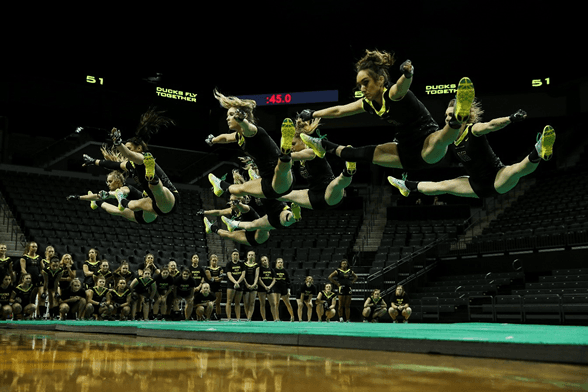
A&T competition is organized around six events: Compulsories, Acro, Pyramids, Tosses, Tumbling, and a Team Routine. Every event draws on a specific combination of roles, and understanding what each role actually does in competition is the first step to understanding your scholarship position.
Top / Flyer: High Visibility, Low Volume
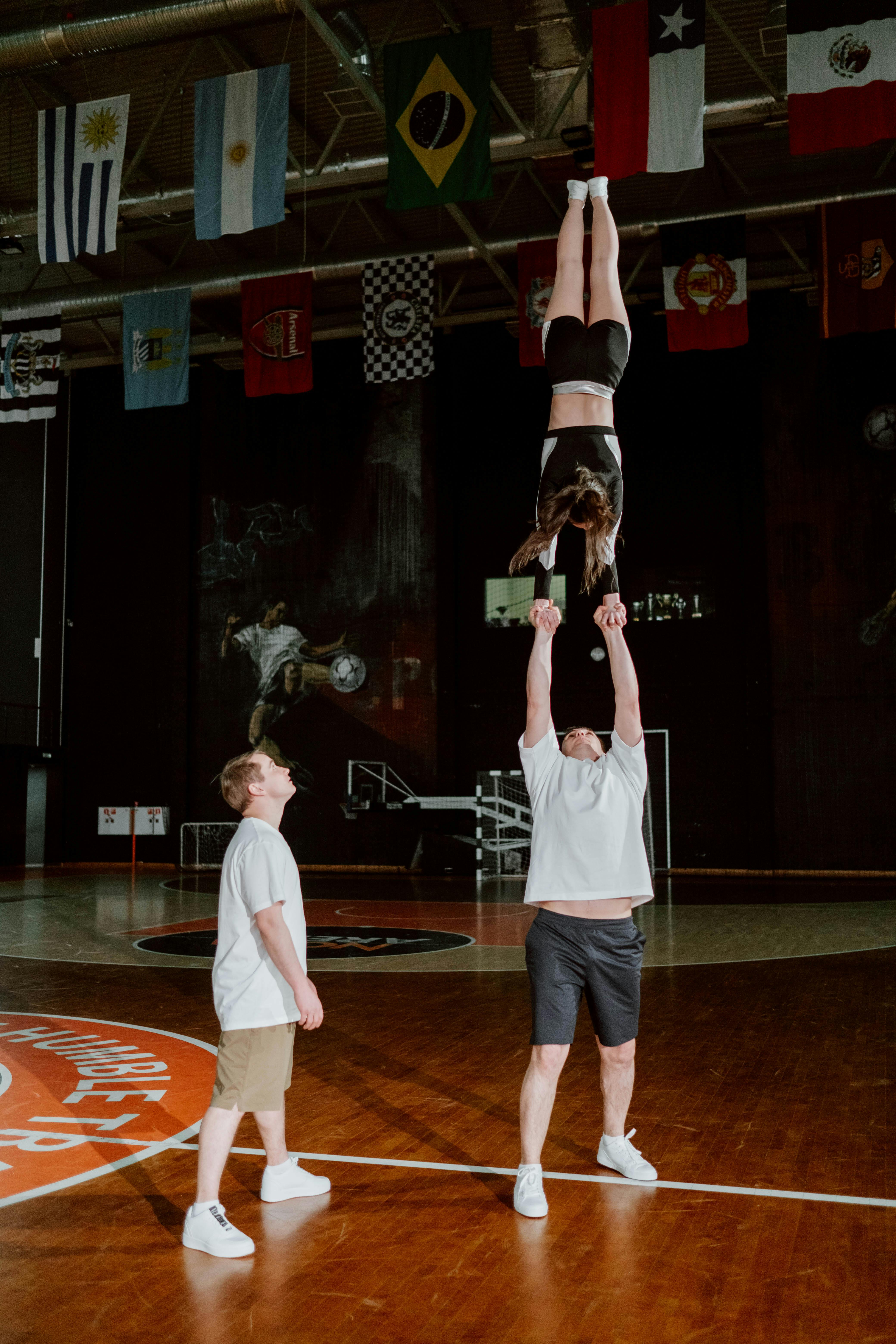
The top athlete is the one in the air — caught, tossed, and held in extended positions. The physical demands are specific: flexibility, body control, aerial awareness, and the ability to stay composed in high-difficulty positions under execution scoring. In the Toss event, a single flyer is worked by up to four bases across multiple synchronized heats — meaning the top's performance directly affects the team's score across several events simultaneously.
Most programs carry multiple tops to cover Compulsories, Pyramids, Tosses, and Team Routine, but there is still only one athlete in the air per stunt. That gap between volume need and structural scarcity is what makes flyer spots feel competitive — and what drives earlier, more intense recruiting attention for elite tops.
Base: High Volume, Undervalued
Bases are the structural foundation of the sport. In the Acro event, heats involve 2-3 base athletes supporting and elevating a top through sequences of increasing complexity. Strength, timing, and spatial precision are non-negotiable. Bases also participate across multiple events without the crossover restrictions that apply to other roles in certain heats — meaning their workload is high and their roster value scales with it.
As programs expand — and expansion is accelerating post-championship status — the base count rises faster than tops or single-pass tumblers. A base who also tumbles is among the most roster-flexible athletes a coach can recruit.
Tumbler: Direct Scoreboard Impact
The Tumbling event accounts for 60 of the 300 possible points in a meet — the single highest-weighted event in A&T competition. Tumblers perform running and standing passes scored on difficulty and execution. A fall or bent-knee pass directly costs the team points in a category that represents 20% of the total available score.
Strong tumblers are also useful beyond the Tumbling event itself — athletes who can contribute clean passes to the Team Routine add value even if they don't compete as tops or bases in other events. That breadth of contribution makes a high-level tumbler attractive to coaches at almost every program tier.
What the Scoring Structure Tells You About Scarcity
This is where the analysis gets useful for families. Meets are scored out of 300 total points across six events, and the weight of each event tells you where a roster gap hurts the most.
Tumblers: Scoreboard-visible in the 60-point Tumbling event. Leverage is highest at newer or mid-tier programs still building depth, where a clean high-difficulty pass is an immediate competitive upgrade.
Bases: Needed in volume across Acro, Pyramids, Tosses, and Compulsories. Leverage is highest where multiple seniors are graduating — study rosters and look for programs with 2-3 senior bases finishing their eligibility.
Tops: Visually prominent and the most actively recruited role at established programs. Leverage is highest at strong programs that are thin in experienced flyer depth — look for programs that consistently score well but show inconsistency specifically in Toss or Pyramid events.
Coaches building toward competitiveness at the first NCAA championship in spring 2027 are solving for all three simultaneously. A gap in any role doesn't just cost them athletes — it costs them points in the events that role anchors.
Athlete Background Shapes the Roster Picture Too
One factor coaches weigh alongside role is where the athlete came from — and that affects roster construction in ways families rarely consider.
NCATA and member-school data show that most A&T athletes come from women's artistic gymnastics and competitive cheer disciplines, with smaller but growing numbers from trampoline, acrobatics, and power tumbling. That breakdown matters because it tells you what most rosters already look like.
A coach building toward balance actively seeks the profile that fills their gap, not the profile that matches what they already have. If your athlete comes from power tumbling, trampoline, or acrobatic gymnastics — backgrounds that are underrepresented in most A&T rosters — that's not a liability. It may be exactly what a coach is shopping for.
For athletes navigating that transition, the From Gymnastics or Cheer to NCAA A&T post covers how coaches evaluate background in detail.
The Championship Effect on Scholarship Urgency
This is the most important context update for families researching A&T right now.
In January 2026, the NCAA officially elevated acrobatics and tumbling to full championship sport status, with the first NCAA championship projected for spring 2027. That's not a background detail — it's a structural change to the sport's recruiting economy.
When a sport earns championship status, programs that were borderline committed become fully committed. Budgets get approved. Some schools that previously ran A&T on small rosters are already adding depth and competing for transfers as they prepare for championship-level competition. At least 48 schools were sponsoring A&T at the varsity level heading into 2024-25, and that number will grow as championship status raises the sport's profile with athletic directors.
If your athlete is in the 2026-27 or 2027-28 recruiting classes, you're entering before the sport's scholarship arms race peaks. Athletes who enter the process now are recruiting into a market where program need is high and competition for spots is still manageable. That window closes.
Most families researching NCAA Acrobatics & Tumbling scholarships ask the same question: how much money is available? That's the right question — but it's incomplete. The more important question is: how much money is available for your athlete's specific role?
Because in A&T, your role isn't just a description of what you do. It's a roster category. And roster categories determine how urgently a coach needs you, how many athletes are competing for the same spot, and how much leverage your family has in a scholarship conversation.
This post breaks down how scholarship value maps to role in A&T — what the competition format tells us about roster construction, where the scarcity actually lives, and what that means when an offer lands in your inbox.
If you're still building your school list while reading this, the Best Colleges for A&T: Smart Target School List post walks through which programs actually sponsor your role and how to build a realistic target list.
First: How A&T Scholarships Work
Before getting into roles, a quick reset on the scholarship structure — because it shapes everything that follows.
NCAA A&T scholarships are equivalency awards, not headcount scholarships. That means coaches don't hand out a fixed number of full rides — they have a pool of scholarship dollars they can divide however they choose across their roster. A Division I program operates under a DI roster cap of 55 athletes, with a program budget that typically covers far fewer than 55 full scholarships.
The practical result: most A&T athletes receive partial scholarships, often stacked with academic or need-based aid to cover more of the bill. Full rides exist, but they're rare and reserved for athletes coaches consider essential to their competitive structure.
Which brings us back to roles. When a coach has limited scholarship dollars and a roster to build, they don't distribute aid randomly. They prioritize the positions where roster gaps create the most competitive risk.
The Three Core Roles — and What Each Demands
A&T competition is organized around six events: Compulsories, Acro, Pyramids, Tosses, Tumbling, and a Team Routine. Every event draws on a specific combination of roles, and understanding what each role actually does in competition is the first step to understanding your scholarship position.
Top / Flyer: High Visibility, Low Volume
The top athlete is the one in the air — caught, tossed, and held in extended positions. The physical demands are specific: flexibility, body control, aerial awareness, and the ability to stay composed in high-difficulty positions under execution scoring. In the Toss event, a single flyer is worked by up to four bases across multiple synchronized heats — meaning the top's performance directly affects the team's score across several events simultaneously.
Most programs carry multiple tops to cover Compulsories, Pyramids, Tosses, and Team Routine, but there is still only one athlete in the air per stunt. That gap between volume need and structural scarcity is what makes flyer spots feel competitive — and what drives earlier, more intense recruiting attention for elite tops.
Base: High Volume, Undervalued
Bases are the structural foundation of the sport. In the Acro event, heats involve 2-3 base athletes supporting and elevating a top through sequences of increasing complexity. Strength, timing, and spatial precision are non-negotiable. Bases also participate across multiple events without the crossover restrictions that apply to other roles in certain heats — meaning their workload is high and their roster value scales with it.
As programs expand — and expansion is accelerating post-championship status — the base count rises faster than tops or single-pass tumblers. A base who also tumbles is among the most roster-flexible athletes a coach can recruit.
Tumbler: Direct Scoreboard Impact
The Tumbling event accounts for 60 of the 300 possible points in a meet — the single highest-weighted event in A&T competition. Tumblers perform running and standing passes scored on difficulty and execution. A fall or bent-knee pass directly costs the team points in a category that represents 20% of the total available score.
Strong tumblers are also useful beyond the Tumbling event itself — athletes who can contribute clean passes to the Team Routine add value even if they don't compete as tops or bases in other events. That breadth of contribution makes a high-level tumbler attractive to coaches at almost every program tier.
What the Scoring Structure Tells You About Scarcity
This is where the analysis gets useful for families. Meets are scored out of 300 total points across six events, and the weight of each event tells you where a roster gap hurts the most.
Tumblers: Scoreboard-visible in the 60-point Tumbling event. Leverage is highest at newer or mid-tier programs still building depth, where a clean high-difficulty pass is an immediate competitive upgrade.
Bases: Needed in volume across Acro, Pyramids, Tosses, and Compulsories. Leverage is highest where multiple seniors are graduating — study rosters and look for programs with 2-3 senior bases finishing their eligibility.
Tops: Visually prominent and the most actively recruited role at established programs. Leverage is highest at strong programs that are thin in experienced flyer depth — look for programs that consistently score well but show inconsistency specifically in Toss or Pyramid events.
Coaches building toward competitiveness at the first NCAA championship in spring 2027 are solving for all three simultaneously. A gap in any role doesn't just cost them athletes — it costs them points in the events that role anchors.
Athlete Background Shapes the Roster Picture Too
One factor coaches weigh alongside role is where the athlete came from — and that affects roster construction in ways families rarely consider.
NCATA and member-school data show that most A&T athletes come from women's artistic gymnastics and competitive cheer disciplines, with smaller but growing numbers from trampoline, acrobatics, and power tumbling. That breakdown matters because it tells you what most rosters already look like.
A coach building toward balance actively seeks the profile that fills their gap, not the profile that matches what they already have. If your athlete comes from power tumbling, trampoline, or acrobatic gymnastics — backgrounds that are underrepresented in most A&T rosters — that's not a liability. It may be exactly what a coach is shopping for.
For athletes navigating that transition, the From Gymnastics or Cheer to NCAA A&T post covers how coaches evaluate background in detail.
The Championship Effect on Scholarship Urgency
This is the most important context update for families researching A&T right now.
In January 2026, the NCAA officially elevated acrobatics and tumbling to full championship sport status, with the first NCAA championship projected for spring 2027. That's not a background detail — it's a structural change to the sport's recruiting economy.
When a sport earns championship status, programs that were borderline committed become fully committed. Budgets get approved. Some schools that previously ran A&T on small rosters are already adding depth and competing for transfers as they prepare for championship-level competition. At least 48 schools were sponsoring A&T at the varsity level heading into 2024-25, and that number will grow as championship status raises the sport's profile with athletic directors.
If your athlete is in the 2026-27 or 2027-28 recruiting classes, you're entering before the sport's scholarship arms race peaks. Athletes who enter the process now are recruiting into a market where program need is high and competition for spots is still manageable. That window closes.
How to Use Your Role as a Recruiting Lever
Most families approach A&T recruiting as if they're applicants. The families who secure better packages understand they're also solving a coach's roster problem.
Before your athlete contacts any program, do two things:
1. Know your role clearly and lead with it. Coaches receive vague outreach constantly. An athlete who opens with "I'm a base and tumbler with a full and double back" gives a coach an immediate picture of where they fit on their roster. An athlete who says "I do cheer and gymnastics" gives a coach nothing to act on. Your role is your recruiting headline.
2. Research which programs have visible roster gaps. NCATA rosters are listed on individual school athletics pages. A program graduating multiple senior bases or tumblers has a predictable need heading into the next recruiting cycle. That need is leverage. Programs that have just added A&T — and there are several in the post-championship expansion — often have the most open scholarship conversations of all.
Once you know where your athlete fits, here's how to approach outreach by role:
If you're a tumbler: Prioritize programs where meet scores lag in the Tumbling event. NCATA box scores are public — find programs that consistently give up points there and position your athlete as the solution.
If you're a base: Target programs graduating multiple bases in the next one to two years. Roster pages list eligibility years; the math is simple.
If you're a top: Study rosters and highlight videos to assess whether a program already carries multiple experienced flyers. If they do, your leverage is lower there. If they're thin, it's higher.
For a full breakdown of programs, scholarship structures, and division-level comparisons, the NAIA and Club A&T Scholarships post is worth reading alongside this one — especially if your athlete is weighing NCAA versus alternative paths.
The Bottom Line
There's no published formula for how A&T coaches divide scholarship dollars by role. But the competition format is public, the roster math is logical, and the patterns are readable if you know what to look for.
Tumblers anchor the highest-value event in the sport. Bases are needed in volume and underestimated by most families. Tops are visible and contested. Every role has a scholarship path — and the families who secure the most money are the ones who understand their athlete's position in a coach's roster equation before they ever send the first email. For the full picture on how A&T scholarships and recruiting actually work across all divisions, the NCAA Acrobatics & Tumbling Scholarships hub is the best place to start.
How to Use Your Role as a Recruiting Lever
Most families approach A&T recruiting as if they're applicants. The families who secure better packages understand they're also solving a coach's roster problem.
Before your athlete contacts any program, do two things:
1. Know your role clearly and lead with it. Coaches receive vague outreach constantly. An athlete who opens with "I'm a base and tumbler with a full and double back" gives a coach an immediate picture of where they fit on their roster. An athlete who says "I do cheer and gymnastics" gives a coach nothing to act on. Your role is your recruiting headline.
2. Research which programs have visible roster gaps. NCATA rosters are listed on individual school athletics pages. A program graduating multiple senior bases or tumblers has a predictable need heading into the next recruiting cycle. That need is leverage. Programs that have just added A&T — and there are several in the post-championship expansion — often have the most open scholarship conversations of all.
Once you know where your athlete fits, here's how to approach outreach by role:
If you're a tumbler: Prioritize programs where meet scores lag in the Tumbling event. NCATA box scores are public — find programs that consistently give up points there and position your athlete as the solution.
If you're a base: Target programs graduating multiple bases in the next one to two years. Roster pages list eligibility years; the math is simple.
If you're a top: Study rosters and highlight videos to assess whether a program already carries multiple experienced flyers. If they do, your leverage is lower there. If they're thin, it's higher.
For a full breakdown of programs, scholarship structures, and division-level comparisons, the NAIA and Club A&T Scholarships post is worth reading alongside this one — especially if your athlete is weighing NCAA versus alternative paths.
The Bottom Line
There's no published formula for how A&T coaches divide scholarship dollars by role. But the competition format is public, the roster math is logical, and the patterns are readable if you know what to look for.
Tumblers anchor the highest-value event in the sport. Bases are needed in volume and underestimated by most families. Tops are visible and contested. Every role has a scholarship path — and the families who secure the most money are the ones who understand their athlete's position in a coach's roster equation before they ever send the first email. For the full picture on how A&T scholarships and recruiting actually work across all divisions, the NCAA Acrobatics & Tumbling Scholarships hub is the best place to start.
It's not the most talented kids who get scholarships.
It's the ones with the right plan.
Our playbooks break down timelines, outreach,
and scholarship realities - by sport.
It's not the most talented kids who get scholarships.
It's the ones with the right plan.
Our playbooks break down timelines, outreach,
and scholarship realities - by sport.